Please note

Because of the lack of published trowel and masonry tool histories, the information here is based on other sources that may be less reliable and certainly are incomplete. These include eBay and tools that I purchase myself that are the starting points for my research. I will write what I know as I learn it. If what you read here interests you, please check back often and look for revisions and corrections. Scanned catalogs are on Archive.org as pdf files. A few are links to other websites. Your photos and information are welcome. Please click on any picture to enlarge it. Comments are welcome, but any with links will be deleted as possible spam.
Showing posts with label American Brick Trowel Makers. Show all posts

Thursday, January 21, 2021

History of Tara Manufacturing Co.

Tara Manufacturing Co. was apparently organized after World War II to make various hardware items, including a limited line of forged brick trowels. The firm's address in 1956 was 2516 S. Archer Ave., Chicago, IL.

W. Bingham Co. hardware catalog 1950

Tuesday, July 2, 2019

History of C.A. Maynard

C.A. Maynard's Hoe and Shovel Works, of Northampton, Massachusetts, manufactured several styles of brick trowels in the late 1800s, along with agricultural tools. Their output was carried as far west as Simmons Hardware Co. in St. Louis, MO.

The works was on the banks of Mill River, below Paradise Pond. The business was originally Clement, Hawkes & Maynard, making cutlery and hoes. C. A. Maynard was Mr. Clement's son-in-law. Maynard died 1 May, 1922, age 80. His obituary stated that he had retired 3 years before, after 53 years in business.

The caption under the picture below reads:

The engravings on this page... represent what is now one of the picturesque objects in the city — the hoe and shovel works of C. A. Maynard, with a few of its products. This factory was badly injured by fire, in 1886, and will probably never again be built in its old form, but Mr. Maynard’s business is increasing so that enlargement must soon be had on the ground floor. The factory is always running full, turns out the highest priced goods in America, and gives the most value for their cost.

This photograph at Digital Commonwealth shows the back of the works before the 1886 fire.

Picturesque Hampshire by Charles Forbes Warner, 1890

 Clement, Hawkes & Maynard cutlery 1869

Sunday, June 17, 2018

Determining the Age of W. Rose Tools

1800s
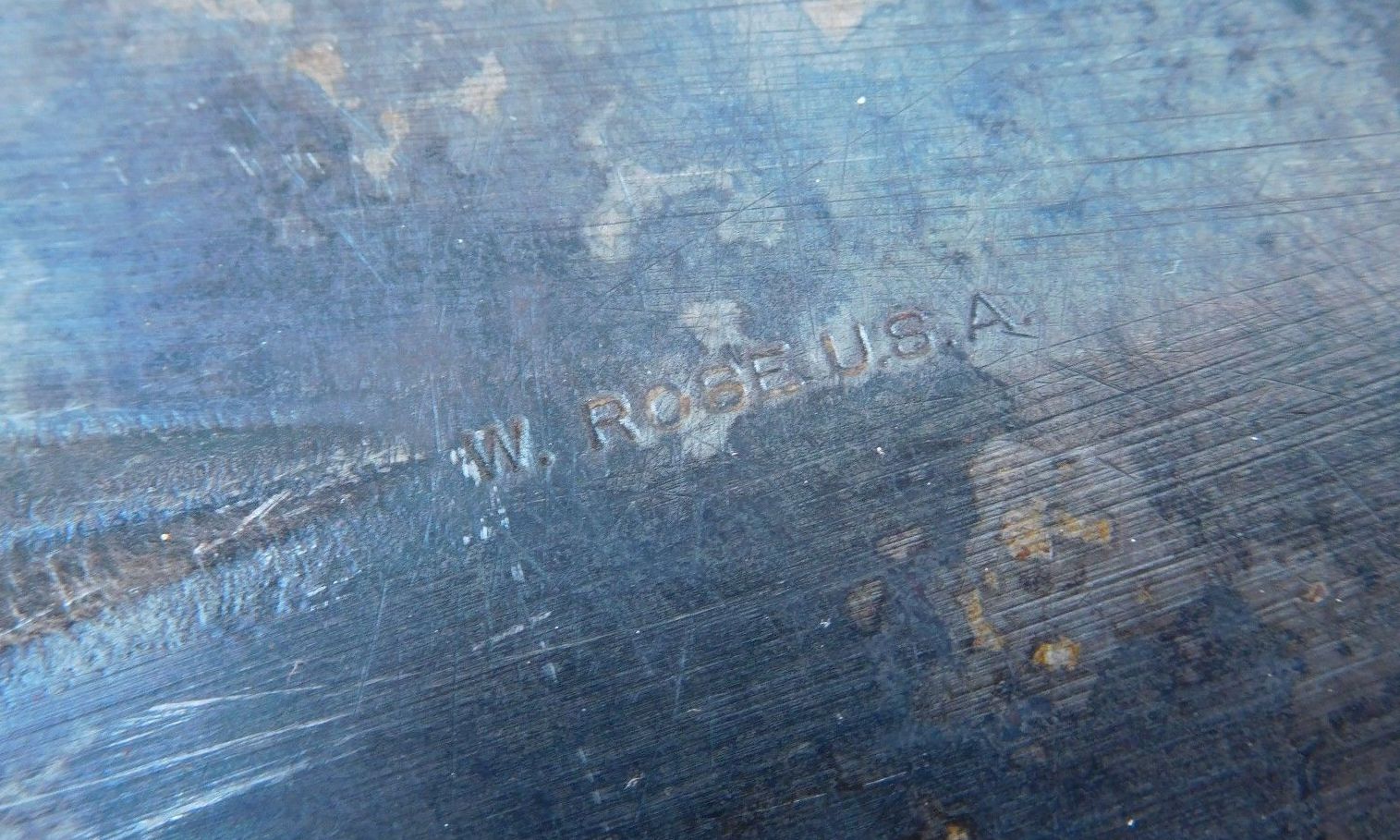
W. Rose has always stamped their forged tools with variations of the business name, and sometimes an abbreviation of West Philadelphia. However, determining when W. Rose made a particular tool is difficult because of the rarity of catalogs and lack of early advertising with pictures. The only scanned catalog available is 1929. The earliest picture in advertising or a hardware catalog is 1897. Advertising of the period shows that between 1909 and 1916 the firm dropped West Philadelphia as the location from their stamp, so it read "W. ROSE".
Before 1916

1887 Advertisement

Before 1916


Another difference is that earlier tools use a serif style lettering, changing to a sans serif on or before 1916.  On most trowels and leather tools, the lettering is right-side up when the tool is held in the right hand, but a few are reversed. These variations and their approximate dates are:
1902 advertisement (serif style lettering is not accurate)  

W. ROSE
Serif style letters, read with handle on the right or the left
1800s

W. ROSE
PHILAD.
Serif style letters, read with handle on the right
1800s

W. ROSE
WEST PHILA.
1916 advertisement
Serif style letters, read with handle on the right
Before 1916

    W. ROSE
WEST PHILA.
Serif style letters, read with handle on the right
Before 1916

  W. ROSE=
WEST PHILA.
Serif style letters, read with handle on the right
Before 1916
1924 presentation trowel (engraved with date) 

W. ROSE/
Sans serif letters
1924

W. ROSE-
Sans serif letters

W. ROSE U.S.A.
Sans serif letters

In recent decades Rose brick trowel handles were stamped:
U.S.A. version
                  W. ROSE
MADE IN U.S.A. SHARON HILL, PA.

The catalog number and length follow W. ROSE.

1959, stamped handle

Friday, December 8, 2017

Determining the Age of a Marshalltown Brick Trowel

The earliest Marshalltown advertisement found is for a plasterer's trowel in 1899:

Marshalltown Evening Times Republican, 13 Oct 1899
Marshalltown introduced their brick trowel in 1908, as this press release in The Iron Age announced:

Their advertisements for Marshalltown's brick trowels show "THE MARSHALLTOWN" stamped in a curve on the blade. This design appeared in ads from 1908 to 1910.

Hardware Dealers Magazine, Vol. 33, 1910

In 1911, the design changed to what appears to be an etching with larger letters, "MARSHALLTOWN" in a straight line. The company used this at least through 1921. After 1921, US copyright law makes finding advertisements much more difficult. 
  
The Bricklayer, Mason and Plasterer, Oct. 1911

Marshalltown's Catalog No. 27 from 1927 shows an etching with large "M" and 2 rings on wood handles. This etching also appears in Catalog No. 45 (date unknown). Trowels from this time also include the product number below U.S.A., but this information is not on the catalog images.  

MARSHALLTOWN
IOWA
U.S.A.

MARSHALLTOWN
IOWA
U.S.A.
No. 19W


The etching above was replaced with a "MARSHALLTOWN" stamp, also with 2 rings on wood handles. Another version includes "USA":

MARSHALLTOWN stamp

MARSHALLTOWN USA stamp

It appears that product number was added next, and earlier ones have 2 rings on wood handles:

19-10
MARSHALLTOWN
USA

By 1974, pictures show the same stamp, and with plain wood handles:

19-10
MARSHALLTOWN
USA

Catalog pictures are not always a good indicator of when tools changed. Manufacturers, wholesalers, and retailers sometimes used old printer's blocks or plates to save the cost of preparing new ones.
Printer's block for Marshalltown brick trowel
   

Saturday, September 2, 2017

History of Heller Majestic Trowels

Heller Brothers Majestic trowel etching
Majestic trowels were first made by Irvin Otto Gierman (28 Oct. 1919 - 8 Aug. 1958), a World War II veteran and welder in Chicago, Illinois. Gierman was unable to find a satisfactory trowel for his personal use, so he decided to attempt manufacturing his own. Upon seeing his work, a large Chicago wholesaler gave him an order for 600 dozen. At its peak, Majestic Trowel made 15,000 dozen annually with a workforce of 20 in Franklin Park, Illinois, near Chicago.

Heller Brothers Majestic No. 310-6 6 inch pointing trowel
On 15 Oct., 1949, Heller Brothers Company of Newcomerstown, Ohio, purchased Majestic and moved all its equipment to Newcomerstown. Heller Brothers put Gierman in charge of trowel manufacturing. Trowels fit with Heller's product line of forged tools, including a brick hammer, many other types of hammers, blacksmith's and farrier's tools, and files of all types.

Heller Brothers Co. sold to Simonds Saw and Steel Co. in 1955, and the name changed to Heller Tool Co.  According to advertisements visible on "snippet view" on Google Books, Heller Majestic brick and plaster trowels were made through at least 1957. They were etched, not stamped, with the name and logo. The etching was light and tended to wear away quickly. This makes Heller Majestic trowels difficult to find and identify today.
Heller Brothers 1.5 pound brick hammer

Hardware Age, 28 July 1949, Pg. 610.jpg


Saturday, September 10, 2016

The Goldblatt No Turn Handle

US Patent 2,076,836
An old and very worn plastering trowel found at a flea market, after cleaning, was revealed as a Goldblatt No Turn Handle. Louis I. Goldblatt was granted US Patent 2076836 on 13 April, 1937, for an innovation in plastering trowel handles. His design turned the aluminum handle mount into a fin, cast integral with the rib and post. The wood handle had a slot cut into the top to receive the fin. The patent drawing shows a small wood screw through the end of the fin and into the wood. As manufactured, the wood screw was replaced by a machine screw completely through the wood, countersunk at its end. Lettering cast into the rib on both sides identifies the trowel:

GOLDBLATT NO TURN HANDLE STREAMLINE PATENTED PATENT NO. 2,076,836

MANUFACTURED BY Goldblatt Tool Co. KANSAS CITY MO USA LAST WORD IN FINE TROWELS

Goldblatt No Turn Handle plastering trowel

Tuesday, June 28, 2016

History of W. Rose, Part Two

In William Rose and the Early History of W. Rose & Brothers, we covered the business from its beginning to when the Rose family sold it in 1894 to O.B. Goodwin. Octavius Barrell Goodwin was born 23 Jul. 1839 in Maine, and his family was well-off enough to send him to Dartmouth College, where he graduated in 1862. He entered the petroleum business in Oil City, PA. We do not yet know what led him to enter tool manufacturing, but he remained active in the oil industry, as did his son.
W. Rose West Phila. in White, Van Glahn & Co. 1902 catalog  
Under Goodwin's ownership, the business retained an agent, the noted Wiebusch & Hilger, Ltd. of New York City. W. Rose began advertising in national trade publications, which proliferated at the turn of the century. Between 1909 and 1916, the firm dropped West Philadelphia as the location from their stamp, so it read, "W ROSE". The business incorporated in 1943, and this is apparently when the name changed from William Rose & Brothers to W. Rose, Inc. The earliest reference I found in print was 1946.

W. Rose advertisement in The Bricklayer, Mason and Plasterer, 1916 
O.B. Goodwin died 14 Jan. 1908 in Philadelphia, and his son became president of W. Rose & Brothers. George Kendrick Goodwin was born 9 Sept. 1881 in Oil City, PA, and received a mechanical engineering degree from Lehigh University in 1904. After just 10 years as president, the business made this announcement in trade publications in 1918:

"Wm. Rose and Bros., makers of the well-known W. Rose trowels and other tools, announce that George K. Goodwin has retired from the firm. The business will be continued by Joseph G. Thatford, at its present location, Sharon Hill, Pa., under the same name."

Joseph G. Thatford was born 17 June 1868 in Philadelphia, and died Nov. 10, 1954 in Delaware County, PA. He began working for W. Rose at about age 20, and by the 1910 U.S. Census he was their plant manager. According to his obituary, he worked for W. Rose for 65 years. Thatford has a US Patent for a manufacturing process for plasterer's trowels. It is not known if Thatford was also part owner of W. Rose. Despite the implications of the 1918 announcement, the Goodwin family retained ownership. George Goodwin's obituary said he retired as president of W. Rose in March 1966.

George Goodwin married Emily H. Stocking (1875–1940), born in Urumiah, Ajerbigan, Persia. It seems probable that their meeting had a connection with the petroleum business. George and Emily had 2 daughters. One of those, Gertrude Murdoch Goodwin, was born 17 Mar. 1909, and received a B.S. in Mechanical Engineering from Cornell University in 1931. She distinguished herself enough at college and in her career that the Gertrude Goodwin Papers are held by the Division of Rare and Manuscript Collections, Cornell University Library.

Gertrude Goodwin went to work as a mechanical engineer at W. Rose soon after graduating. In 1967 she became president of W. Rose, and ran the business until her retirement in 1989. She never married, and lived in what had been her parent's home at 300 N. Sharon Ave., in Sharon Hill, within walking distance of the W. Rose plant. She died 15 Dec. 1997.

When Ms. Goodwin retired, all of the W. Rose stock was sold to employee Edward B. King, whose 3 sons also worked for W. Rose. Edward King (29 Dec. 1925 -  22 Nov. 2011) retired at age 67 in 1992, after 52 years at W. Rose. Glenn King became president, Larry J. King was production manager, and Edward J. King was in charge of maintenance.

In 2001, Kraft Tool Co. purchased W. Rose, Inc. from the King family, and they have continued the tradition of craftsmanship that began with the first William Rose.

W. Rose 1917 advertisement
Through the ownership and management changes that W. Rose has seen in more than 2 centuries, there are a number of qualities that have remained constant and which set W. Rose apart. First, the quality of their tools has remained high. Second, Rose has always had management that valued stability in all aspects of the business. Third, their employees are dedicated and some have worked for the company for decades. It is near-certain that there is an unbroken chain of employees going back to William Rose and Sons. Next, W. Rose has always been privately held, and not subjected to the variations of the stock market or the whims of a conglomerate, holding company, or venture capitalists. Next, they have never over-diversified their product line. Last, W. Rose is the only US tool manufacturer I am aware of that has been run by 2 women at different times. Having one woman as manager or owner is very rare, and having 2 is completely unique.


More material will be added to this article. If you have family photos or other material, please contact me.

Tuesday, June 14, 2016

William Rose and the Early History of W. Rose & Brothers

William Rose sword, War of 1812
The history of the company we know as W. Rose began with Peter Rose (1720–1766), who married Mary Gardiner (1727–1796). The family lived in Blockley Township on the western edge of Philadelphia County, both incorporated into the City of Philadelphia in 1854. Peter and Mary owned at least 2 tracts of land, which were in the name of Mary Rose in 1777. Peter was a joiner (carpenter or woodworker) and farmer, and the family had a mill on Mill Creek. The creek is also not on today's maps because it was forced underground as a storm and sanitary sewer beginning in 1869, and the land leveled for building. The Rose's land on Mill Creek began at today's Clark Park on Chester Ave., and ran north between today's S. 43rd St. and S. 46th St., with a corner crossing Market St.

William Rose, born 13 Jan. 1754 in Blockley Township, was only 12 when his father died. William trained as a cutler and may have taken over his father's mill at some time. The W. Rose history on the Kraft Tools website gives 1798 as the date William started the business. In addition to William's first military contract in 1781, his skill as a cutler, his sons' skills, the size of his shop at his death, and the family's owning their water rights all point to the business beginning much earlier. Since trades were passed from father to son, it's possible there were other cutlers in his family. Preliminary research shows several cutlers from the 1600s in Hallamshire named Rose, a William Rose who was a cutler in Dublin in the 1580s, and another Peter Rose who was a noted early medical instrument maker in New York City.

In 1781 William received an advance from Deputy Commissary General Samuel Hodgdon of 980 pounds of iron and 12 pounds of steel to produce bayonets. He made just 200 bayonets, but produced bar iron from his own furnace for Hodgdon through the end of the war in 1783. From this beginning, William and his sons, especially Joseph, made cavalry sabers for local militias, sabers and officer's swords for the Philadelphia Arsenal, cutlasses for sailors, ramrods, and bayonets. They were best known for making blades, but could also make the entire sword. An example is a US government contract dated 9 Dec.1807 for 2,000 cavalry sabers at $5.125 each. By the War of 1812 they could make a brass-mounted artillery sergeant's sword for $4.125.

American Revolution bayonet by William Rose
Some of the Rose's most noted work was the blades for 72 presentation swords ordered by Congress for naval heroes during the War of 1812. Examples of these and others made by William and his sons are in the collections of major American museums, including the Metropolitan Museum of Art and the Winterthur.

By 1807, the business was called William Rose & Sons. The 4 sons who became cutlers were:

1807 W. Rose & Sons sword
William Rose (23 Feb. 1783 - 29 Jan. 1854) remained in the business, as did 4 of his sons.

Benjamin Franklin Rose (10 Oct. 1785 - 26 Sep. 1828), after getting his start with his father and brothers, moved to Philadelphia by 1819 and became a surgeon's instrument maker.

John Rose (6 May 1788 - 10 Jan. 1828) is listed as a cutler in Blockley in 1819.

Joseph Rose (20 Dec. 1788 - 27 Sep. 1819) remained a cutler in the business until his unexplained death. His brothers Benjamin and John were administrators of his estate, which is how we know their occupations.

The Book of English Trades, 1827
When William died 19 Mar. 1810 in Somerset, PA, his will described him as a cutler. The inventory of his estate includes his tools, equipment, raw material, and work in progress. From this, we know that the Rose works was producing brick and plastering trowels, sickles, several types of swords, gun barrels, and bayonets in 1810. There were enough men working to justify having 4 wooden tilt hammers, 4 wrought iron tilt hammers, 9 small grindstones and 2 large grindstones. These facts all suggest a business that was well established earlier than 1798. At some time after 1810 the business was named William Rose & Brothers.

Reading the 4-page inventory of Joseph's estate from 9 years later, one gets a sense of the tragic loss of a talented and versatile young artisan. Our consolation is that it also provides us with a valuable window into his life and the business in 1819. The papers refer to a mill and a "new mill". Fortunately there is a map from 30 years later that shows "J. Rose Mills" with 2 buildings and just north of it, "Roseville". The mill was powered with a race from Mayland's Dam, a pond about 2 blocks long, in the center of the Rose property shown in on the 1777 map. We know from other sources that Mill Creek was swift and had carved a deep and narrow valley to the Schuylkill, ideal for water power. Mayland's Pond would have been deep, with the mill situated in a ravine, indicated on the 1849 map.

By 1849 the city street grid had jumped the Schuylkill River and was platted to today's 41st St., with portions of 43rd St. going from Market St. south to J. Rose Mills. This allows us to plot the location of Rose's Mill. It corresponds exactly with the location of the worst of Philadelphia's infamous Mill Creek sewer collapses, the block bounded by Walnut and Sansom, S. 43rd to S. 44th Streets. The north side of Walnut collapsed in the 1930s, and the south side of Sansom in either or both 1955 and 1971. All houses in this block were demolished. The mill's tailrace matches with 43rd St. south of Walnut, where the street has caved into the sewer several times since 1930.


The next generation at William Rose & Brothers were all sons of the younger William. William Rose Jr. (24 Mar. 1810 - 28 Sep. 1883) was in charge of shipping and sales. Joseph Rose (29 Sep. 1823 - 5 Jun. 1881) specialized in plastering trowels. Rudolph Frailey Rose (17 Mar. 1825 - 11 Jan. 1886) was in charge of tempering, and in the 1863 Pennsylvania census his occupation was cutler. John Wesley Rose (26 May 1828 - 28 May 1886) was responsible for grinding.
McElroy's Philadelphia Directory 1839
The first Philadelphia city directory entry for William Rose is 1839, with the address as "Washington (W P)", meaning Washington Street or Road, West Philadelphia. This could refer to the closest main road to the mill, today's Market St., or the 1849 map could have been out of date. By 1844, we are certain that the business had moved east to a more advantageous commercial location, near the first bridge over the Schuylkill River. The earliest known advertisement for the firm was 1844, see below. The 1853 city directory specified Washington St. near Bridgewater St., which are today's Market St. and S. 30th St. This central location offered surrounding industry, a coal dealer, nearby river transportation, and the railroad.
O'Brien's Philadelphia Wholesale Business Directory, 1844
By 1862, Market St. proved much more valuable for the railroad than for a cutler's works. The business moved again to the corner of S. 36th St. and Filbert St., previously Green St., where they remained until 1889. That area has been redeveloped and no old buildings remain.

Philadelphia and Its Manufactures, by E.T. Freedley, 1867
In 1886 the only surviving partner was J. Wesley Rose, and Sarah J. Rose (1843-1921) took over management from 1887 through 1894. Sarah J. Rose was married to William's son John Frailey Rose (1841-1920), who was a physician in Oxford, Chester County, PA. At the time of the 1890 city directory, the business had moved to Sharon Hill, and 1889 corresponds with a 1918 article in Hardware World. In 1894 the Rose heirs sold the business to Octavius Barrell Goodwin. This will be covered in another article.

W. Rose West Phila. round knife
Products made during the Rose family's ownership included swords, brick trowels, brick jointers, brick hammers, scutches, plastering and finishing trowels, foundry molder's tools, saddler's round knives, and probably others. The business did little advertising during this period, but were listed with other trowel makers in hardware compendiums. The 1844 and 1867 advertisements are the only ones I have located from before 1894.     

Older W. Rose tools have the abbreviation "WEST PHILA." stamped after the name. This term was in use before the area was incorporated into Philadelphia. After the 1854 Philadelphia city-county consolidation, the entire area west of the Schuylkill was called West Philadelphia, a name which continues to today. By 1916, Rose had dropped location from their stamp. On some tools the location is in smaller letters, and on others it is the same size as the name. This article is continued at History of W. Rose, Part Two.

W. Rose West Phila. presentation trowel, rosewood handle
Two versions of the early stamp on brick trowels
Rose sword references and photographs:
The American Sword 1775-1945, by Harold L. Peterson
ArmsCollectors.com, Four Big Black Swords
Damon Mills, American War of 1812 Philadelphia Made Officer's Sword by Joseph Rose
Delaware Historical Society, Regulation 1813-21 Foot Officer's saber stamped I. Rose
The Metropolitan Museum of Art, Congressional Presentation Sword and Scabbard of Peleg K. Dunham 
Winterthur Museum, The Tale of the Sword: A Celebration of Patriotism and Valor

Monday, February 15, 2016

Astle Tool Co. of Annandale, NJ, and Union Steel Tool Co., Plainfield, NJ

Iron Trade Review, Vol. 47, 1910
Steel, Vol. 48, 1911
Astle Tool Co. of Annandale, New Jersey and Union Tool Steel Co., Plainfield, NJ were connected by the same tool maker. George W. Astle was born 10 Oct., 1861, in New Jersey, and died in 1941. Astle was trained as a blacksmith by his father, James T. Astle. George Astle made a brick trowel, mill picks, facing hammers, and other tools for stone. He worked in Annandale in Hunterdon County up to 1910, when he joined with businessmen Thomas F. Budlong and Ellsworth P. Baylor to form Union Steel Co., also called Union Steel Tool Co., with offices in nearby Plainfield, Union County, NJ. Apparently the business was short-lived or was bought by another tool maker, because no advertisements or articles appear after 1911. Union Tool Steel Co. is not listed in the 1912 Plainfield directory.

There is more information about George W. Astle in the book, Early Tools of New Jersey and the Men Who Made Them, by Alexander Farnham. Astle's brick trowel is pictured on page 65. It is deeply stamped G. W. ASTLE ANNANDALE, N.J. U.S.A. An 1886 panoramic map of Annandale shows James T. Astle's shop.

G.W. Astle mill pick head

Wednesday, February 3, 2016

C.M. Long Trowel Co., Toledo, Ohio

The Bricklayer Mason and Plasterer, April 1918
C.M. Long Trowel was a small company that was in business in Toledo, OH from 1918 to the early 1920s. Clyde M. Long, C.C. Montis, Asa Smith, T.P. Crawford, and H.M. Crawford filed for incorporation 19 March, 1919, with capital of $10,000. Clyde Merit Long was a union brick mason and also an inventor with at least 2 US patents. He ran the company from his home at 728 Parker Ave., but it is not known where the tools were manufactured. As pictured in the 1921 advertisement, he made a forged brick trowel, plasterer's finishing and browning trowels, and a level with an adjustable vial in pine or mahogany.

The brick trowel has a distinctive crook in the shank (neck), which would make it easy to identify to a collector today. This feature was advertised as being more ergonomic and giving greater control, but the curve was reduced between the 1918 and 1921 ads. The trowel was made in 2 widths and 2 pitches (heights, lifts), with wood or leather handle.

Clyde Merit Long was born in Ohio 22 Dec., 1877, and died after 1937. He married Sarah Almina Smith, and their one child, Asa Alden Long, was a world and US checkers champion, a game he learned from his father and grandfather.

Company ads appeared prominently from April 1918 to 1921 in The Bricklayer, Mason, and Plasterer, the journal of the Bricklayers, Masons, and Plasterers International Union of America. The ads stated that their tools were invented by Clyde M. Long, but I was unable to find any US patents for trowels or levels. He received US Patent 1,162,790 for prepared mortar on 7 Dec., 1915, and US Patent 1,547,178 for a milk-bottle holder on 28 July, 1925.
The Bricklayer Mason and Plasterer, 1921

Thursday, September 3, 2015

History of H.A. Lothrop Manufacturing Co.

H.A. Lothrop, of Sharon, Massachusetts, was one of the first American brick trowel manufacturers. As early as 1864, their trowels had patterns and handles that other manufacturers would use 50, 75, and 100 years later. Their tools are in the 1864 New York City hardware catalog of Blevin, Mead & Co.

Because others have researched Horace A. Lothrop's life, I won't repeat it here. Mr. Lothrop (1828-1898) had factories for trowels and cutlery, operating as H.A. Lothrop Manufacturing Co. In 1876 the trowel factory had 14 employees and the cutlery factory had 25. After his death, the company name changed in 1899 to H.A. Lothrop Co. His sister was married to Oliver Ames Jr., of shovel manufacturer Oliver Ames & Sons of nearby Easton, MA.

The complete Bliven, Mead & Co.'s "Illustrated Catalogue and Price List of American, German, English and French Hardware" is located here.

H.A. Lothrop advertisement, 1893

Lothrop's XX brick trowel, handle unknown  

Wednesday, June 24, 2015

Marshalltown Company's 125th Anniversary in 2015

I received this in comments:

Marshalltown Company is celebrating its 125th Anniversary this year and we're looking for antique Marshalltown tools. If you have anything you're willing to part with or know someone who does, please email Marketing@Marshalltown.com


The oldest Marshalltown trowel I own 
Marshalltown has made limited edition trowels celebrating their anniversary, seen here on YouTube.  

Marshalltown 1910 advertisement
The MARSHALLTOWN 125th Anniversary Limited Special Edition Box Set includes:
1 Laser Engraved Trowel of your choice (Finishing, London Style, Philadelphia Style, or Archaeology)
1 T-Shirt & 1 Polo
2 Historical MARSHALLTOWN photos
1 Limited Edition Display Box

Each set is $115 and is available for a limited time.