Please note

Because of the lack of published trowel and masonry tool histories, the information here is based on other sources that may be less reliable and certainly are incomplete. These include eBay and tools that I purchase myself that are the starting points for my research. I will write what I know as I learn it. If what you read here interests you, please check back often and look for revisions and corrections. Scanned catalogs are on Archive.org as pdf files. A few are links to other websites. Your photos and information are welcome. Please click on any picture to enlarge it. Comments are welcome, but any with links will be deleted as possible spam.
Showing posts with label Continental European Trowel Makers. Show all posts

Saturday, August 26, 2017

History of Peugeot & Compagnie, Pont-de-Roide

Peugeot & Cie. was a major French tool manufacturer in Pont-de-Roide and Bourguignon, in Bourgogne-Franche-Comté region, near Switzerland. The company's founders were descendants of the Peugeot family of industrialists, and children of James Jackson (1771-1829), an Englishman who emigrated to France in 1814 to make steel. In 1838 William Jackson married Louise Peugeot, and Georges Léonard Peugeot married Anna Jackson, establishing a union of families and business.

In 1842, 4 sons of Jean-Frédéric Peugeot joined with 4 Jackson brothers, establishing themselves at Pont-de-Roide to make tools and other articles. Their enterprise changed names several times over the following decades:

1846 Peugeot Aînés et Jackson Frères (Peugeot Elders & Jackson Brothers)
1866 Peugeot Jackson et Cie. (Peugeot Jackson & Co.)
1889 Peugeot Aînés et Cie. followed by Peugeot Frères et Cie. (Peugeot Brothers & Co.)
1907 Peugeot et Cie.

In 1933 Peugeot & Cie. merged with Les Fils de Peugeot Frères, but production continued at Pont-de-Roide until 1936. There 1932 catalog is on the Internet Archive.

Peugeot & Cie. works at Pont-de-Roide 
Peugeot’s products included a variety of trowels for masonry and brick, masonry hammers, a full line of saws from back saws to large circular and band saws for mills, wood chisels, planes, and coffee mills. Their coffee mills are actively collected, and most internet resources are about their coffee mills.

Pont-de-Roide is at the confluence of 3 small rivers, the Doub, Roide, and Ranceuse. The availability of water power to operate trip hammers and grindstones made it an attractive industrial site. By 1932, the Peugeot & Cie. catalog shows large, modernized plants with their own hydroelectric plants.  


Peugeot & Cie. masonry trowels
Peugeot & Cie. brick trowels

Monday, July 3, 2017

History of Coulaux & Compagnie

Coulaux & Compagnie was a French manufacturer of tools and armaments, with manufacturing in Klingenthal, Molsheim, Mutzig, and Gresswiller. The operation at Klingenthal is famous for its swords. The Molsheim plant made tools, including a full line of brick trowels and finishing trowels. The arms manufacturing dates to 1729, and the business closed in 1962. More information (Français) (English), and here (German).

Their 1932 catalog is on the Internet Archive:
Coulaux & Cie. Truelles et Platoirs, Transplantoirs, Couteaux, Binettes  (Trowels & Finishing Trowels, Garden Trowels, Knives, Hoes)

A larger 1931 catalog is also on the Internet Archive:
Coulaux & Cie. Petit Outillage 1931 (Small Tools)

Sunday, July 17, 2016

Lohmann & Co. German Export Trowels

Lohmann & Co. logo
Lohmann & Co. was a tool manufacturer and exporter in Bremen, Germany. Lohmann was founded about 1891, and their logo was a double bullock (ox). The pages below are from an undated Lohmann catalog from the interwar period. The complete 230-page catalog shows that Lohmann was able to make all types of hand tools, and to reproduce popular tools from countries to which they were exporting, including Britain and the United States.


Monday, January 12, 2015

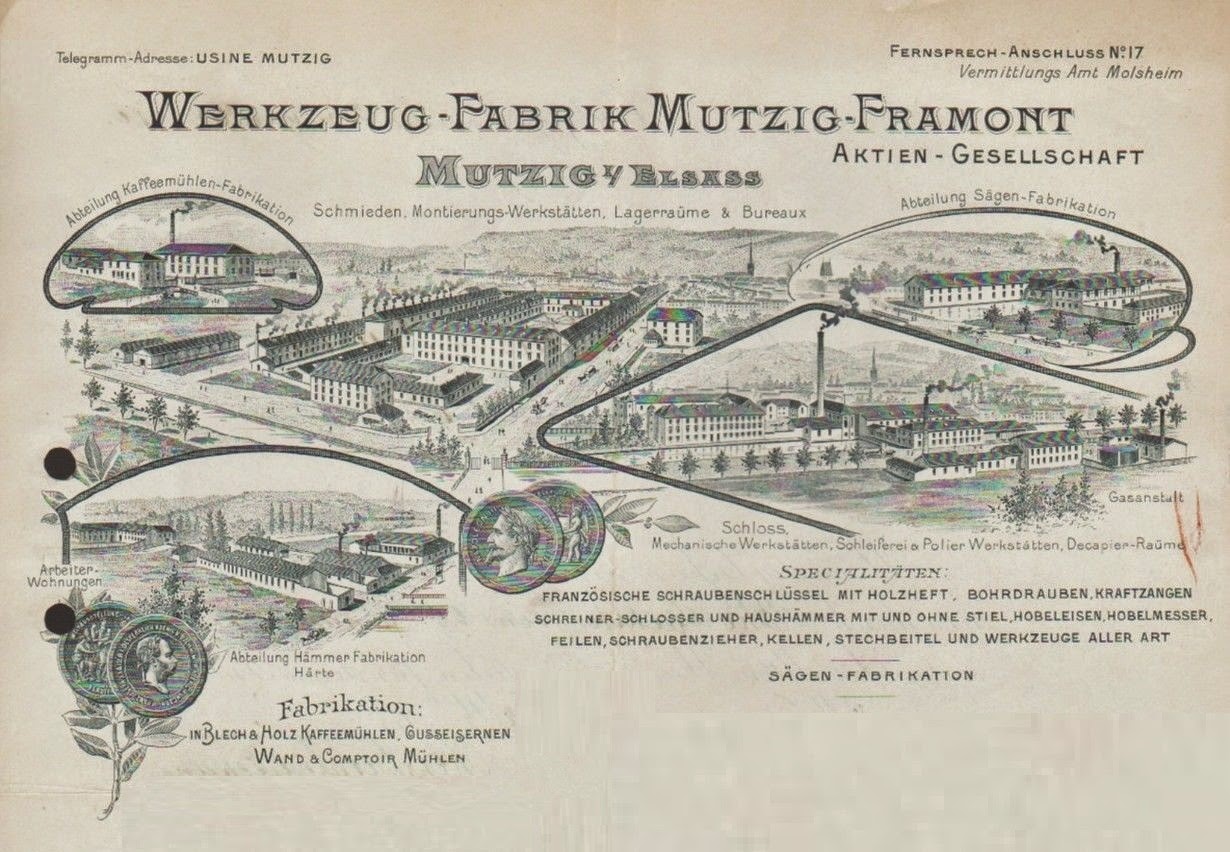
Mutzig-Framont, Alsace

Mutzig-Framont was a hardware manufacturer in Mutzig, Alsace. Mutzig was in Germany from 1871 until 1918-19, and has been in France since then. According to one history, the firm was founded in 1873 and closed in 1932.

Mutzig-Framont's products lines were divided into hardware and coffee grinders, with separate factories and catalogs for each. While more coffee grinders than tools survived, some tools can be found on eBay in France and elsewhere.

Postage stamps with Mutzig-Framont tools
Mutzig-Framont patents
Études statistiques sur l'industrie de l'Alsace, Volume 1, 1879
French trowels on display at Maison de l’Outil

Mutzig-Framont factories
1879 article
Mutzig-Framont trowel 

Thursday, September 25, 2014

Gießerei-Lanzette, German Foundry Molding Tools

Foundry molding tools are called Gießerei-Lanzette in German. Wikipedia - Lanzette (Gießerei)

W. or M. Barth made foundry molding tools in Cannstatt, an ancient town which became a district of Stuttgart, Germany in 1905. This short description of Barth's business is an 1895 book, "Beschreibung des Oberamts Cannstatt":

"...die mechanische Werkstätte von M. Barth in Cannstatt, welche als Spezialität Formwerkzeuge verfertigt und in Deutschland, sowie nach Österreich-Ungarn, Bosnien und Luxemburg exportiert…"

"...the mechanical workshop of M. Barth in Cannstatt, which manufactured specialty molds and exported to Germany and to Austria-Hungary, Bosnia and Luxembourg..."

Beschreibung des Oberamts Cannstatt
W. Barth foundry molding tool (top)
German foundry molding tools

Tuesday, September 16, 2014

Swedish Bricklaying Tools, Svenska Murarverktyg

Sweden has a very long tradition of making steel and tools, as described by Tekniska museet (Technical Museum) in Stockholm:
Ferrum – Swedish Iron and Steel through the Ages

KGC, founded 1950, is one of Sweden's trowel makers. Following is a translated quote from their website KGC History

Karl Gustav Cederberg, a skilled concrete worker, started the KGC's Bricklayer’s Tools 1 April 1950. KGC quickly became known for its high quality and good service, two qualities that still permeate the company.

In the 1950s there were not many shippers, thus KGC bought a Ford Anglia and delivered himself to building sites around the Stockholm area and up to Uppsala, which was then almost a day trip.

1966 sold the company to the Cederberg Hadar Gustafsson streamlined production and increased range. [In 1966 the company sold Cederberg to Hadar Gustafsson as streamlined manufacturing and extended range.] In 1979 KGC was acquired by Orwar Eriksson. On first September 2005, Patrik Wahlfridsson and Mats Engqvist took over the company.  The first catalog contained 30 products, most of them made ​​by KGC. 25 of these are still in the range and further approximately 1800 products. Many products are now, as then, developed by the KGC and we always listen to the end user to find optimum solutions to problems.

Tuesday, August 26, 2014

Bellota Trowels, Corporación Patricio Echeverría of Spain

Bellota is a brand of Corporación Patricio Echeverría, of Legazpi, Spain, founded in 1908 by Patricio Cirilo Echeverría Elorza. Bellota has a full line of trowels for bricklaying, plastering, stucco, and concrete finishing, in several regional styles. Bellota still makes a traditional wood handle decorated with 2 or 3 rings, which other trowel makers abandoned decades ago. Bellota construction tools catalog in pdf form (Spanish)

Bellota plastering trowel (Llana Lisa Mango Madera 5864 Bellota)
Patricio Echeverría (1882-1972) was a manufacturer, inventor, and philanthropist in Legazpi, in the Basque region of northern Spain. Although his family were paper makers, Echeverría took up the forging trade. After completing his apprenticeship in Legazpi (or Legazpia) , he worked in forges in nearby Mondragon (also called Arrasate). In 1904 he returned to Legazpi and opened his own blacksmith shop. In 1908 he founded Segura, Echeverría and Co. (Segura, Echeverría y Cía) with a partner. The modest factory of 12 workers made agricultural, mining, carpentry, and masonry tools. Due to business differences the partnership dissolved in 1909, and Patricio continued on his own as Corporación Patricio Echeverría. The factory had 106 workers at its beginning, grew to 453 employees in 1931, and had 3,400 at his death in 1972.

Antique Bellota trowel (paleta de albañil) 
Echeverría was an innovator in metalworking and manufacturing. In his first forge shop in 1906 he patented a method of forging a hoe or rake (Patent No. 38,511). Later patents included metal polishing (1931), circular saw (1933), double column eccentric press (1933), mechanical press gooseneck (1934), and a metal bender (1936). Echeverría also adopted innovations by others. The first was a technique in manufacturing blades which he found on a trip to England in 1920. Another, in 1931, was an Austrian method of manufacturing scythes. Echeverría built a vertically integrated business in phases, beginning with an electric furnace in 1931, a mill, and the production of special steels. After a reorganization in the 1990s, the company ceased production of steel, lamination, and stamping parts.

In the 1920s Corporación Patricio Echeverría began to use the Acorn name and logo for its products. A conflict arose with the English firm Henry Taylor Tools, although Echeverría’s acorn appeared upside down from Taylor’s logo. Echeverría negotiated the use of the symbol in exchange for a 35,000 peseta payment to Taylor.

Antique Bellota trowel
Echeverría believed in sharing his business success with his workers and his community. His good works were recognized with a Spanish title in 1958.

Translated quote from Wikipedia biography Condado de Echeverría de Legazpia (Spanish)

The County of Echeverría of Legazpia (El Condado de Echeverría de Legazpia) is a title of Spanish nobility created by the Head of State Francisco Franco, on August 18 of 1958, in favor of Patricio Echeverría y Elorza, Basque metallurgical businessman, son of artisans, distinguished by his great work for society: homes, schools, libraries, nursing, and tuberculosis prevention.

The peerage was given by:

“The extraordinary merit that brings this great Spaniard, who has dedicated his life to the enhancement of the industry and the social and moral improvement of the factory workers, and deserves to be rewarded with a title of nobility that remembers the recognition of the Motherland of  one of the most significant in the task of raising the standard of living of Spanish men."

Decree granted in daily ABC , July 18, 1958, page 37

Biography & photograph of Patricio Cirilo Echeverría Elorza (Spanish)
Google Maps - area of Corporación Patricio Echeverría, Legazpi

Following is a quote from the company website:

Present in more than 120 countries, with 11 registered brands and more than 18,000 references and a team of 1,400 employees worldwide, Corporación Patricio Echeverría has manufacturing plants in Legazpi (Spain), Zumarraga (Spain), Olloqui (Spain), Illinois (USA), California (USA), Fortin de las Flores (Mexico), Manizales (Colombia), Indaial (Brazil), Hovedgard (Denmark) and lastly Nashik (India). Our headquarters are located in Legazpi, Spain, in the so-called “Valley of Iron” in Guipuzcoa where Patricio Echeverría founded the company in 1908. Corporación Patricio Echeverría has two main divisions: The Hand Tool business unit...[and] The Agrisolutions business unit....
Bellota trowels and spreaders of today

Tuesday, June 17, 2014

Aux Forges de Vulcain Paris, The Forges of Vulcan

Aux Forges de Vulcain was a venerable French tool seller and manufacturer in Paris, with a variety of tools for masonry, carpentry, mechanics, measuring, and other trades.

Aux Forges de Vulcain brass trowel
Aux Forges de Vulcain history (French) Edited translation:

Aux Forges de Vulcain, a shop in the center of Paris, was a tool retailer and distributor from 1807 to 1974. At times they manufactured their own tools and also marked their name on products made by others.

According to a history in Vulcain’s 1951 catalog, the business began in 1807 when a Mr. Bavoil owned a restaurant and grocery frequented by tradesmen, especially stone masons. Mr. Bavoil saw an opportunity to increase his sales, and added tools and small hardware to his stock. When the tools proved more profitable, he quit the grocery trade and adopted the name, Aux Forges de Vulcain.


Initially, the business did not manufacture tools. In 1829 they began marking their name on planes made by others that they sold. Paulin-Desormeaux recommended the establishment of M. Bavoil as the best for matching the right tools for the price. Bavoil would not be confused with its close neighbor Fleet of England, which carried beautiful luxury tools. At this time, Vulcain sold "French and foreign hardware, steel, limes, brass, son of iron, steel and brass, grinding wheels, stones, ...tools for arts and manufacturing, lathe turnings...." 


Bavoil’s son Perrot ran the business from 1843 to 1846. Manufacturing likely started in 1847 with the arrival of Denis Youf, who may have been from an old family of woodworkers in the Faubourg Saint-Antoine. Trade Almanac mentions from that date that the Forges of Vulcan were a "workshop for the manufacture of woodworking tools and machines.”


Aux Forges de Vulcain received an honorable mention in the exhibition of 1849 for "two lathe turnings manufactured in its workshops" and a medal at a trade show in 1855. The first  catalog of mounted tools manufactured by the house is 1864. There is a brief mention of all the items sold by the house, metals and other materials, hardware, machines and tools for "gardeners, sculptors, carvers, engravers, smelters, modelers, tanners, gunsmiths, tinsmiths and coppersmiths, precision tools for building workshops." There is also an extensive range of 450 models of planes manufactured for "carpenters, cabinetmakers, piano builders, coach builders, coopers, carpenters and wheelwrights."


The business prospered, but in 1857, the premises occupied by The Forges of Vulcan was expropriated for urban redevelopment to beautify Paris. In 1860 a new store opened on the Place du Châtelet at no. 3 rue Saint-Denis. “The banner depicting Venus leaning on the shoulder of Vulcan was executed on porcelain by one of our most illustrious porcelain painters, MA Jean, and placed on the facade of our business where it is known to all Parisians." 


In 1896 the house was mentioned as a distributor and not as a manufacturer. It had probably stopped making planes while continuing to sell a thousand other articles. Vulcain sold planes for nearly a century and a half, but did not manufacture them during the second half of the nineteenth century. Tools marked "Aux Forges de Vulcain" generally date to the second half of the nineteenth century, but it is possible that the business later marked the tools it resold.


The business’s success inspired other hardware sellers to adopt similar names, prompting the long-standing Parisian business to state, "The house has no branches," prior to its opening branches in Bordeaux (1917), Lyon (1918) and Lille (1920).


In the twentieth century, Vulcain regularly published thick tool catalogs, sold plant equipment and machinery, and up to the Second World War carried most of the models of planes manufactured in France. The house also had a machine shop in suburban Saint-Denis. Distribution of most planes stopped after World War II, and the business closed in 1974.


The names of successive owners was compiled after reading trade almanacs. This list presents some differences with the oldest dates provided by the catalogs of the second half of the twentieth century, also contradicted by other sources and probably less reliable. 


1810-1842: Bavoil (catalogs say 1807-1825)
1843-1846: Perrot, son of the previous (catalogs say 1825-1845) 
1847-1859: Denis Youf 
1860-1871: Jules and Victor Chouanard, brothers 
1872-1890: Jules Chouanard 
1890-1931: Emile Chouanard, his son 
1931-1935: Henry Chouanard-Bres, son of previous, manager since 1911 
1936-1941: Roger Francis 
1943-1974: Marcel Drye, nephew of Henry Bres-Chouanard and Lucien Lebeurre. 
. 
 Addresses: 
 1810-1860: 1, rue de la Barillerie, a location that is sometimes referred to 18, rue Martroi  
 1860-1974: 3, rue Saint-Denis

Aux Forges De Vulcain Catalog For Sale

Aux Forges de Vulcain stamp
Aux Forges de Vulcain catalog