Please note

Because of the lack of published trowel and masonry tool histories, the information here is based on other sources that may be less reliable and certainly are incomplete. These include eBay and tools that I purchase myself that are the starting points for my research. I will write what I know as I learn it. If what you read here interests you, please check back often and look for revisions and corrections. Scanned catalogs are on Archive.org as pdf files. A few are links to other websites. Your photos and information are welcome. Please click on any picture to enlarge it. Comments are welcome, but any with links will be deleted as possible spam.
Showing posts with label Stone and Terazzo Tools. Show all posts

Tuesday, December 13, 2016

Granite City Tool Co.

Granite City Tool Company is a major tool and machinery supplier to the stone trade. I have scanned Granite Tool's Catalog No. 12, from about 1952, and uploaded it to Archive.org.

Granite City took over making Dallett pneumatic tools in the 1940s. I have also scanned a Dallett Company catalog from the early 1930s, also at Archive.org.

The Google Street View below shows Granite Tool's Barre, Vermont buildings, surrounded by old stone sheds.

Monday, May 30, 2016

Hand Saws for Stone Cutters and Masons

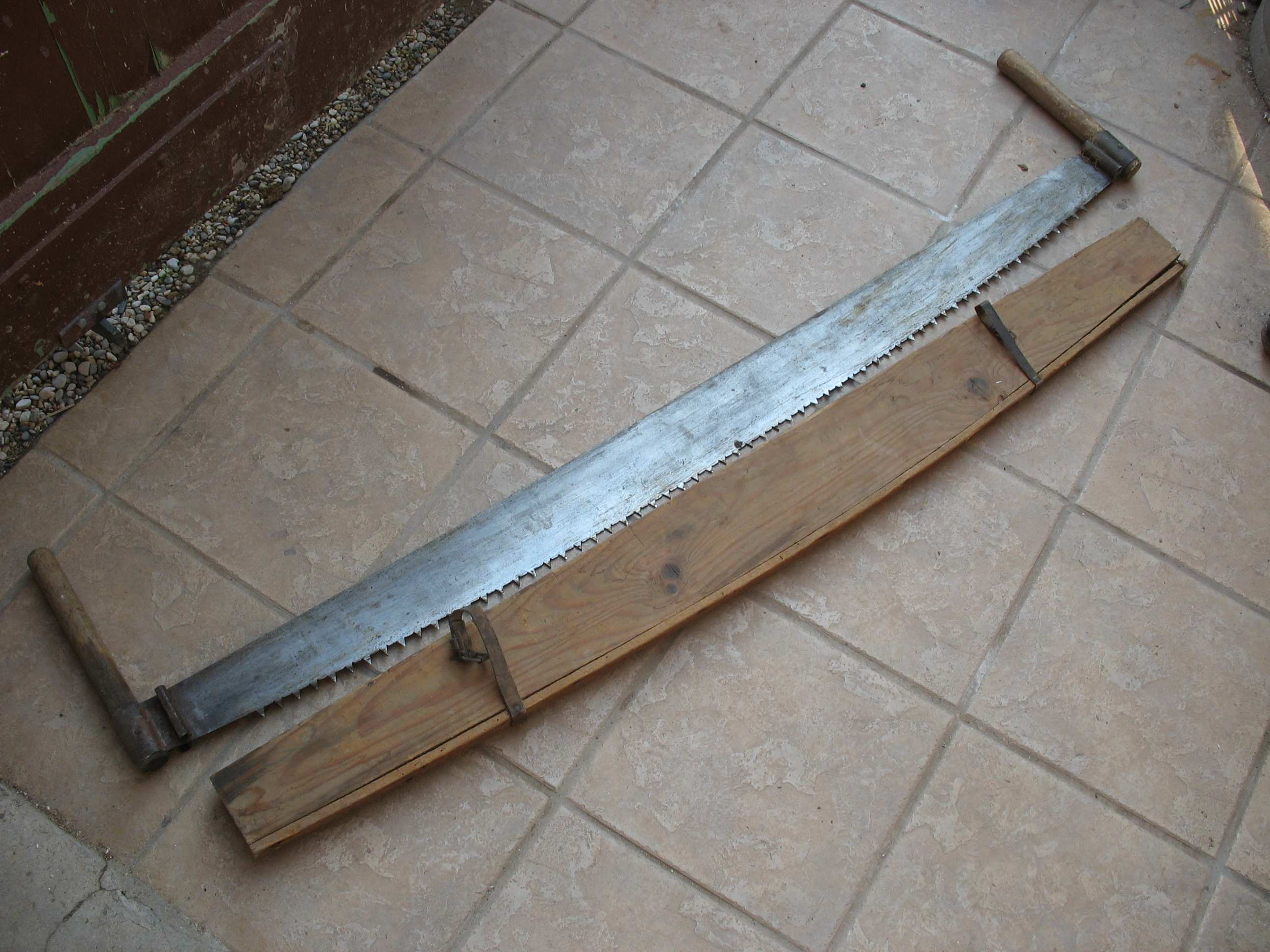
Hand saws have been used to cut stone since antiquity, and were made as recently as 1940 by Joseph Tyzack, Meersbrook Works, Sheffield. The 2-man saw in the bottom picture is French.

J. Tyzack 1940 Catalogue

Étival Clairefontaine, France
Image du Blog tonton84.centerblog.net
Source: tonton84.centerblog.net  sur centerblog.
This YouTube video shows retired stone cutters demonstrating how limestone blocks were cut in the 1950s.

Saturday, January 23, 2016

Mallets, Mauls, and Dummys

Masonry: An Elementary Text-book..., 1914
Mallets, mauls, dummys, and similar hammers are the only masonry tools that are also used for other crafts. These short-handled hammers are used to strike chisels or other steel tools in soft stone cutting, stone carving and letter cutting, woodworking, wood carving, leather working, and jewelry making.

The traditional mallet has a wood head, the maul has a leather head, and the dummy's head is brass, copper, bronze, zinc, pewter, steel, cast iron, or wrought iron. The modern dummy can also be nylon or urethane. Handles are commonly hickory in the US, and elm or beech in the UK and Ireland.

The heads are round, usually an inverted truncated cone, which has several advantages over the standard one- or two-faced hammer or mallet. The user does not have to keep the hammer head aligned with the chisel and can keep his/her eyes on the work. A round wood head reduces the risk of the wood splitting, proves a wide wearing surface, and gives extra weight. A round metal head will not mushroom, the force of the  blow being distributed across a wider area.
Wood mallet, USA

Metal dummy from Pembrokeshire, UK
Masons' Mallet .—These tools are very important to the mason. They are usually made of beech or hickory. Pearwood, if well selected, is also excellent for this purpose. The beat of the mallet, or that portion coming into contact with the chisel head, is on the end grain of the wood. It is a speculation, when buying a mallet, as to whether it will prove a success or not. When a craftsman secures a good mallet he prizes it beyond all the other items in his tool kit. They are used in sizes according to the material or the detail to be cut, and in conjunction with the mallet-headed tools. From Modern Practical Masonry, by E.G. Warland, 1929.

Cast iron dummy by Tiranti of London
Mauls and dummys are traditional designs with a long history, but beginning in the early 19th century, inventors began patenting leather mallets or mauls. These use rings or discs of leather or cardboard, compressed by threaded iron or steel rings on a threaded steel shaft.

An early patent that was manufactured was by Allen P. Partridge (1806-1872) of Medway, Massachusetts, with US Patent 46,972, issued 21 March 1865, and US Patent 127,363, issued 28 May 1872. With his son David Allen Partridge (1833-unk.), he operated Allen Partridge & Son 1870-71, and David also worked as agent (salesman) and treasurer for West Medway Mallet Co. from 1875 to 1886. The 1865 patent has a rod which extends through a hollow wood handle, with a large screw slot at the top. The 1872 patent has a large hex nut with patent information at the base of the head, and the handle is solid wood and extends through the head. Medway had shoe manufacturing and marble and granite finishing businesses, and it's clear from Partridge's 1865 application that his mallet was to be used in those trades. Some West Medway mallets also say NEA & N Co. or UA & N Co., in addition to W. Medway at the base of the head.
West Medway No. 4 maul, US Patent 46,972
Partridge maul, US Patent 127,363
George B. Goddard of Brockton, Massachusetts obtained US Patents 202,165, 211,149, 414,808, 662,691, and 763,553 for leather mallets and a mallet handle. Goddard patent mallets were manufactured by Brockton Mallet and Machine Co. An 1897 article in Iron Age said, "The company are manufacturers of and wholesale and retail dealers in all kinds of Mallets, Mauls, Hammers, etc., being exclusive makers of Goddard's patent Raw Hide Mallet, Leather Covered Chisel and Bicycle Handle, and Goddard's Raw Hide Pinking Roll."

Goddard maul, US Patent 662,691 
New leather mauls are available in the US from C.S. Osborne and Wirsing.

The Complete Book of Trades, 1842
Don Dougan has additional information about the long history and uses of these tools, from a stone carver's perspective.

Thursday, December 24, 2015

Millstone Tools

The Miller, Millwright and Millfurnisher, 1882
Millstones were used for grinding grain, pigments, graphite, and other granular substances. As millstones wear from use, they need to be dressed, meaning resurfaced, as shown in the YouTube videos below. The primary tool used is a mill pick, also called millstone pick or a mill bill and thrift, which is a steel mill pick head that is wedged into a thick wooden handle. This article, "The life and times of Michaelchurch Mill" has a picture of millstone dressing tools. The high spots on the stones are checked with a wooden paint-staff onto which red oxide or chalk is rubbed. The paint-staff is can be checked for straightness against a cast iron proof-staff.
Most US manufacturers of stone mason's tools made mill picks at some time. Several small businesses and probably many individual blacksmiths specialized in forging mill picks and resharpening them. Used picks would be delivered or mailed back, to be heated, the edges drawn out, tempered, then sharpened on a grindstone. These small US makers included John C. Higgins & Son of Chicago, IL, J. Knight of Baltimore, MD, and J. G. Pollard of Brooklyn, NY.

The Roller Mill, Vol 17, 1898


Millstone pick, J. Knight, Baltimore


The Roller Mill, Vol 17, 1898
Millstone pick, Norway (missing one bit) 

Monday, December 21, 2015

Joseph Richards and the Patent Hammer

The patent hammer has a number of sharpened thin steel blades which are bolted into a heavy head, and is used for finishing granite and hard sandstones. The blades are called "cuts" and were available in sets of 4, 6, 8, 10, and 12 cuts per side by varying the thickness of the steel used for the cut. The most common jaw opening was 7/8", and other sizes from 1/2" to 1" were offered. Cuts were also used to specify the number of grooves per nominal inch, as an 8-cut finish. The patent hammer produced a grooved surface much faster than a hand chisel, and the cuts were easily removed for sharpening. Other names for the patent hammer were patent bush hammer, Scotia hammer, and patent Scotia hammer. Scotia hammers were usually smaller, with 5/16" and 3/8" jaw openings. The picture to the right shows patent-hammered work on Old City Hall, Richmond, VA. This YouTube video shows a bush hammered finish with a different hammer. Excellent photographs of patent-hammered work are in the 1938 booklet Granite in Architecture at Archive.org.

Richards' patent drawing
The patent hammer was invented by Joseph Richards (1784-1848) of Braintree, Massachusetts. The US patent was issued 20 Feb. 1828 for a "Stone-Working Tool". The retroactive patent application number is X5010 or 5010X. His invention spurred many other inventors' designs for patent hammers. There are at least 55 more US patents for hand hammers and chisels with multiple blades which can be removed from the head for sharpening. The US Patent Office classified them as mill picks or bush hammers, avoiding confusion with any other patented hammers. I have saved these patent applications and drawings into one pdf file, which is here.

Fayette Plumb patent hammer, 1906 
Patent hammers were made and/or sold by Brunner & Lay, H.H. Harvey (5 styles), J.M. Kent, George Main, Nutting & Hayden, Plumb, Trow & Holden (2 styles), Pinel Brothers, Vulcan, Wilcox & Donahue, and others. Five of these companies were in the Quincy, MA area. Several manufacturers stamped serial numbers and manufacturing dates on their patent hammers.
Patent hammers were used in cutting sheds (Wooster, MA)
A History of Old Braintree and Quincy: With a Sketch of Randolph and Holbrook, by William Samuel Pattee, 1879

Mr. Joseph Richards (1), of the former firm of Richard & Munn, was a man of uncommon ability and intelligence, and was possessed of much inventive genius.  About the year 1831, he invented the bush, or axe hammer; which term is the more proper we are not able to say, as no name for it is to be found in any of the dictionaries, although this instrument has been in use about half a century.  The name of bush hammer is evidently local, as at Philadelphia and some other places, it is called axe hammer, from the several little axes being keyed into the cheeks of the instrument, and we think it the most correct name of the two.  There are six, eight, ten, or more axes connected with it. The number used depends upon the fineness the artisan desires to dress the stone.  This useful instrument to stone-cutters was first made by Mr. Richards, solid or wholly in one piece, for which he received a patent; since then improvements have been made upon it by constructing it in several pieces. [Richards' patent is for a design with several pieces.]

(1) Hon. Joseph Richards was born in Cummington, Mass., Aug. 20th, 1784, and was educated in the District School.  When about twelve years of age, he removed with his parents to the northern part of the State of New York, where he was engaged with his father in farming, until he was eighteen years of age, when he left home and came to Quincy.  His first engagement in this town was with President John Adams, as coachman, who after a few months’ service in that capacity, suggested to him that he was worthy of a higher position.  From those suggestions of Mr. Adams, he went to Abington, where he undertook the duties of a school teacher, a position for which by nature he was eminently qualified even at that early age. possessing as instinctive knowledge of human nature, he governed without force or coercion.  He was an ardent lover of the science of mathematics, in the higher branches of which he was quite proficient.  Form Abington he returned to Quincy, or “Braintree Neck,” (now Quincy Neck) in 1803, where he engaged, for many years, in quarrying and working stone with Bryan Newcomb, his future father-in-law, in the summer, and school teaching in the winter until the increase of the stone business in which he was engaged, engrossed his whole time.  Although obliged to abandon the profession in which he delighted, his love of knowledge continued unabated until the close of his successful life, Feb. 12th, 1848.  He was chosen to the State Senate for the years 1843 and ’44.  Mrs. Richards survived her husband a number of years.
Trow & Holden hammers & chisel, 1910
If you have a Trow & Holden patent hammer as in the 1910 advertisement, please take note. In addition to the 4 large bolts, there are 2 steel pins holding the head together. These pins are ground flush so may not be visible. Clark Holden's patent drawing shows 2 smaller bolts in this position. As later manufactured, these were replaced with 3/8" pins. If you have one, do not attempt to pry the head apart unless absolutely necessary, and you must drive the pins out first. All parts except the bolts should be replaced in the same locations.    

Monday, February 2, 2015

History of Trow & Holden Co.


Trow & Holden cutter's hand hammer No. 237
Trow & Holden Co. is an iconic American maker of excellent quality tools for working stone, operating in Barre, Vermont, since 1890 (or 1889). Their tools were used to create the Lincoln Memorial, among many other notable monuments, sculptures, and buildings. They have a large number of videos on their YouTube channel, demonstrating their hand and pneumatic tools. One measure of their tool's high quality is that the pneumatic tools have serial numbers, and No. 1 still exists. It belongs to Barre sculptor Giuliano Cecchinelli, seen here on Facebook.

Trow & Holden was founded by Clark Holden (1834-1909), a native of Barre, the heart of Vermont's granite industry. At age 21 he bought the general store where he was employed. In 1865 he and a partner, Frank A. Stafford, bought a Barre agricultural fork manufacturer and ran it as the Stafford-Holden Co. and the Stafford & Holden Manufacturing Co. In 1885 Clark Holden withdrew from the business to serve as postmaster of Barre for 5 years. In 1889 he formed a partnership with John Trow, a banker, to make granite tools under the name Trow & Holden.

Trow & Holden's factory, 1906
In 1905, Clark Holden sold the business to his son, William Merrill Holden (1873-1941). The firm had outgrown its facility, and William Holden bought the Stafford & Holden Manufacturing Co.’s buildings on South Main St. in Barre. The site included a dam on Stevens Branch for powering the forges and grinding wheels. In 1911, the business incorporated as Trow-Holden Co. This aerial photograph is in a 1942 book.

The company passed to William’s son Max Albee Holden (1899-1973), who married Eula Mary Akley. Max Holden brought his wife’s brother Gordon E. Akley (1920-1992) into the business. When Max retired around 1969, Gordon Akley bought the rest of the shares.

Today, Gordon Akley’s son Norman Akley and his wife Lauren LaMorte own Trow & Holden.
According to a 2012 article, all of Trow & Holden’s products are made with CNC machines, but the plant has its original line shafts. The old water-powered drop forges and other antique equipment is stored on site, seen in a 2008 photo on Flickr, in 2014 on Facebook, and a 2008 video tour on YouTube.

Trow & Holden 1-3/4 pound cutter's hand hammer
Trow & Holden Co. 1926 catalog
Family biographies in 1914 book
Trow & Holden plant on Google Streetview
Barre Granite Association, The Sculptor monument
Rock of Ages granite quarry tour, Barre

Trow & Holden hand bush hammer No. 3L

Tuesday, December 30, 2014

History of Nutting & Hayden, Concord, NH

1890
Nutting and Hayden described themselves as manufacturers of granite cutters’ and quarry tools. Their office and factory were at  12 Ferry St., Concord, New Hampshire. There are no old buildings located at this site today. The business began in 1881 as a partnership between Luther Morse Nutting (1846-1924) and Henry W. Hayden (1856-1917). Mr. Nutting patented a bush hammer design, US 412,532, ‎filed Mar. 12, 1885, issued Oct. 8, 1889.

According to a 1906 Concord directory, Walter O. Sweet owned Nutting & Hayden and his residence was at 93 N. State St., Concord. Walter Orrin Sweet (1877-1916) married Daisy Ethel
Hayden (1881-1969), daughter of Henry W. Hayden and Eliza L. Loring Hayden.

The most recent advertisement found for Nutting & Hayden is 1907, although it is possible the business continued past that date. The article is from The Leading Business Men of Concord, and Vicinity, Embracing Penacook, East and West Concord, by George Fox Bacon, 1890.

Stone; an Illustrated Magazine, Volume 2, 1889
Nutting & Hayden bush hammer

Friday, December 5, 2014

History of W.H. Anderson, Detroit, Michigan

W.H. Anderson was a manufacturer and supplier of tools for stonemason's tools, cement tools, and other tools. They were located at 14 and 16 Macomb St., Detroit, Michigan, but no old buildings are in this area now. William Henry Anderson (1837–1914) founded the company in 1870 or 1871, took his 3 sons into the business, and it operated at least to World War II, when Harold Stewart was president. They used the names W.H. Anderson & Son, W.H. Anderson & Sons, and Anderson Tool & Supply Co. Here is a complete catalog of their cement tools from about 1910:
W.H. Anderson's Tools and Supplies for Cement Workers

Many of Anderson's stone hammers and chisels can be seen in this circa 1940 catalog; tools for working stone begin on page 35 of the scanned copy: J.M. Waterston Catalog

William Henry Anderson
"William H. Anderson, of the firm W.H. Anderson & Son, manufacturer of stonecutter’s tools and supplies, was born in Edinburgh, Scotland, in 1837. He received a liberal education and learned the tool and smithing trade. In 1856 he emigrated to America, spending some time in New York State. He settled in Detroit in 1861, working as a journeyman at his trade. In 1865 he became mastersmith at Fort Wayne, in the employ of the government, remaining three years. In 1868 he went to Pittsburgh, Pa. In 1870 he returned to Detroit and founded his present manufacturing business, purchasing a lot and erecting his factory and smith shop, of 40x106 feet, and 3 stories high, at Nos. 14 and 16 Macomb Street. In 1886 his son, James D. Anderson, was admitted as partner. William Anderson married Janet [or Jannet] McVittie in 1863. She was born in Scotland and died in 1865, leaving one son, James D., who was born in 1864. William Anderson married Elizabeth McVittie [Jannet's older sister] in 1871. They have three children, William R., Gilbert J., and Mary M."
History of Detroit and Wayne County and Early Michigan, 1890

In 1919 the company celebrated its 48th anniversary, and all 3 of the founder's sons were officers:
James D. Anderson, president 
Gilbert J. Anderson, vice president
William R. Anderson, secretary Biography
Article on Google Books

Set of Anderson stone chisels


Anderson brass edger
Anderson chisel


W.H. Anderson brass groover

Saturday, September 6, 2014

Roman Mosaic Hammer


The Roman mosaic hammer, or mosaic hammer, is used with a small anvil called a hardie or hardy to cut smalti (glass), stone, and marble for mosaic and terrazzo work. The hardie is usually driven into a wood block. This technique and tools are reportedly 2,000 or more years old.

Dimosaico.com - tools
YouTube - Roman mosaic hammer & hardie

Mosaic hammer
Roman mosaic

Mosaic hammer and hardie

Macadamizing Hammer

The macadamizing hammer has a round head when viewed from the top, making every side a striking surface. It can be several shapes in the third dimension, including spherical, oval, ovoid, or disc-shaped. The handle length varies more than other hammers, from about 10 inches (25 cm) to 18 inches (46 cm) or 30 inches (76 cm) or more. Like other hammers for working stone, these were usually sold without handles, allowing the user to choose the best handle for the work. The macadamizing hammer was simply used to break or pulverize stone for road construction. Other names are macadam hammer, nappan knocker, and napping or knapping hammer.

"Macadam is a type of road construction pioneered by Scottish engineer John Loudon McAdam around 1820. The method simplified what had been considered state of the art at that point. Single-sized aggregate layers of small stones, with a coating of binder as a cementing agent, are mixed in an open-structured roadway." Wikipedia Macadam

Macadam hammer from Maine, USA
Macadamizing hammer in new condition (USA)

Evansville Tool Works (USA) macadamizing hammer
French macadamizing hammer 
Macadamizing hammer, 12-3/4" handle


Monday, July 28, 2014

Slater's Tools

The page from the book "Building Construction" by Henry Adams illustrates and describes 2 traditional tools for working slates, the slater's zax (axe) and slater's hammer. Google Books

Early 20th century slater's tools
"Building Construction" 

Monday, July 7, 2014

Tools For laying Cobblestones

Stone paving for roads, sidewalks, and courtyards has been used since about 4000 BC. The stones used can be round river rocks or irregular split stone, called cobbles or cobblestones. Stones trimmed into rectangular shapes are called setts or Belgian blocks. Most old cobblestones that are not river rocks are quarry waste, chunks too small to be used for other purposes. Granite is the preferred rock for paving, if it is available.
Laying cobblestones, Hammond, Indiana
The stones are set in a base of crushed stone (small mixed aggregate), crusher run (mixed aggregate of all sizes), stone dust (the smallest crushed aggregate), sand, or earth. The advantage of the mixed particle sizes is that it is easily shoveled and raked when delivered, and compacts under pressure and water into a cohesive mass. For paving, the cobblestones are usually not cut by the installer since the sizes vary, but they may be trimmed.

Traditional tools for laying cobblestones, setts, and other paving blocks include the following:
Paving hammer, USA
Flat bladed shovel
Rake or other spreading tool
Pick
Wheelbarrow
Paving hammer for trimming
Stone chisel
Wooden or rubber mallet
Stiff broom
Mason’s line
Level

Brades Co. City Road paving hammer, UK


Boston pattern paving hammers, USA

Tuesday, April 29, 2014

Stone Chisels

Types of stone chisels include the following:
Toothed chisel (2-tooth, 3, 4, 5, 6, etc.)
Flat chisel
Bolster chisel or drove chisel
Point, or point chisel
Angle chisel, skew chisel, or miter chisel
Rondel chisel, round chisel, or bullnose chisel
Inverted rondel chisel
Gouge
Cape chisel or splitter
Lettering chisel 
Generally they are sized small, medium, or large.   

Stone chisels made to be struck with a steel hammer are called hammer head. Mallet head chisels have larger, mushroom-shaped heads that won't damage a wooden mallet.    

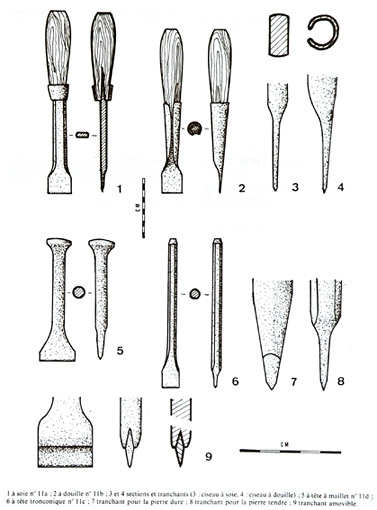
Here are several photos from eBay of stone chisels, and at top an image of traditional French designs.
Traditional French stone chisels

Stone chisels in canvas roll

Toothed stone chisels (mallet heads)

Toothed, flat, rondel, and point chisels (hammer heads)