Please note

Because of the lack of published trowel and masonry tool histories, the information here is based on other sources that may be less reliable and certainly are incomplete. These include eBay and tools that I purchase myself that are the starting points for my research. I will write what I know as I learn it. If what you read here interests you, please check back often and look for revisions and corrections. Scanned catalogs are on Archive.org as pdf files. A few are links to other websites. Your photos and information are welcome. Please click on any picture to enlarge it. Comments are welcome, but any with links will be deleted as possible spam.
Showing posts sorted by relevance for query hammer. Sort by date Show all posts

Friday, January 17, 2014

Hammers For Working Stone

Hammers of all types are collectible in their own right. There are more hammers for working stone than for any other trade. Here is a list of names from the USA and the UK, and there are more hammers and alternate names for hammers than I have here.

Bell hammer
Brass hammer
Bull set
Bush or bushing hammer
Chipping hammer
Cleaver
Crandall
Double blade masons hammer
Facing hammer
Finishing hammer
Furrowing hammer
Hand hammer
Hand drill hammer
Mash hammer
Masons club hammer
Masons punch hammer
Mill pick
Mosaic hammer
Quarry hammer
Patent hammer
Rifter hammer
Rock hammer
Rock hammer, double edge
Rock hammer, single edge
Round hand hammer
Roundhammer
Rubble hammer
Scotia hammer
Scottish dykers hammer
Scutch
Scutch hammer
Slab splitter
Sledge hammer
Solid tooth bush hammer
Stone mason hammer
Stone setting hammer
Striking hammer
Toothed stone axe
Toothed stone hammer
Trimming hammer

YouTube Stone Hammer Types

Here are 2 current manufacturers of stone hammers:

Trow and Holden (Vermont, USA)
Rebit Stone Tools (Sweden)


Monday, December 21, 2015

Joseph Richards and the Patent Hammer

The patent hammer has a number of sharpened thin steel blades which are bolted into a heavy head, and is used for finishing granite and hard sandstones. The blades are called "cuts" and were available in sets of 4, 6, 8, 10, and 12 cuts per side by varying the thickness of the steel used for the cut. The most common jaw opening was 7/8", and other sizes from 1/2" to 1" were offered. Cuts were also used to specify the number of grooves per nominal inch, as an 8-cut finish. The patent hammer produced a grooved surface much faster than a hand chisel, and the cuts were easily removed for sharpening. Other names for the patent hammer were patent bush hammer, Scotia hammer, and patent Scotia hammer. Scotia hammers were usually smaller, with 5/16" and 3/8" jaw openings. The picture to the right shows patent-hammered work on Old City Hall, Richmond, VA. This YouTube video shows a bush hammered finish with a different hammer. Excellent photographs of patent-hammered work are in the 1938 booklet Granite in Architecture at Archive.org.

Richards' patent drawing
The patent hammer was invented by Joseph Richards (1784-1848) of Braintree, Massachusetts. The US patent was issued 20 Feb. 1828 for a "Stone-Working Tool". The retroactive patent application number is X5010 or 5010X. His invention spurred many other inventors' designs for patent hammers. There are at least 55 more US patents for hand hammers and chisels with multiple blades which can be removed from the head for sharpening. The US Patent Office classified them as mill picks or bush hammers, avoiding confusion with any other patented hammers. I have saved these patent applications and drawings into one pdf file, which is here.

Fayette Plumb patent hammer, 1906 
Patent hammers were made and/or sold by Brunner & Lay, H.H. Harvey (5 styles), J.M. Kent, George Main, Nutting & Hayden, Plumb, Trow & Holden (2 styles), Pinel Brothers, Vulcan, Wilcox & Donahue, and others. Five of these companies were in the Quincy, MA area. Several manufacturers stamped serial numbers and manufacturing dates on their patent hammers.
Patent hammers were used in cutting sheds (Wooster, MA)
A History of Old Braintree and Quincy: With a Sketch of Randolph and Holbrook, by William Samuel Pattee, 1879

Mr. Joseph Richards (1), of the former firm of Richard & Munn, was a man of uncommon ability and intelligence, and was possessed of much inventive genius.  About the year 1831, he invented the bush, or axe hammer; which term is the more proper we are not able to say, as no name for it is to be found in any of the dictionaries, although this instrument has been in use about half a century.  The name of bush hammer is evidently local, as at Philadelphia and some other places, it is called axe hammer, from the several little axes being keyed into the cheeks of the instrument, and we think it the most correct name of the two.  There are six, eight, ten, or more axes connected with it. The number used depends upon the fineness the artisan desires to dress the stone.  This useful instrument to stone-cutters was first made by Mr. Richards, solid or wholly in one piece, for which he received a patent; since then improvements have been made upon it by constructing it in several pieces. [Richards' patent is for a design with several pieces.]

(1) Hon. Joseph Richards was born in Cummington, Mass., Aug. 20th, 1784, and was educated in the District School.  When about twelve years of age, he removed with his parents to the northern part of the State of New York, where he was engaged with his father in farming, until he was eighteen years of age, when he left home and came to Quincy.  His first engagement in this town was with President John Adams, as coachman, who after a few months’ service in that capacity, suggested to him that he was worthy of a higher position.  From those suggestions of Mr. Adams, he went to Abington, where he undertook the duties of a school teacher, a position for which by nature he was eminently qualified even at that early age. possessing as instinctive knowledge of human nature, he governed without force or coercion.  He was an ardent lover of the science of mathematics, in the higher branches of which he was quite proficient.  Form Abington he returned to Quincy, or “Braintree Neck,” (now Quincy Neck) in 1803, where he engaged, for many years, in quarrying and working stone with Bryan Newcomb, his future father-in-law, in the summer, and school teaching in the winter until the increase of the stone business in which he was engaged, engrossed his whole time.  Although obliged to abandon the profession in which he delighted, his love of knowledge continued unabated until the close of his successful life, Feb. 12th, 1848.  He was chosen to the State Senate for the years 1843 and ’44.  Mrs. Richards survived her husband a number of years.
Trow & Holden hammers & chisel, 1910
If you have a Trow & Holden patent hammer as in the 1910 advertisement, please take note. In addition to the 4 large bolts, there are 2 steel pins holding the head together. These pins are ground flush so may not be visible. Clark Holden's patent drawing shows 2 smaller bolts in this position. As later manufactured, these were replaced with 3/8" pins. If you have one, do not attempt to pry the head apart unless absolutely necessary, and you must drive the pins out first. All parts except the bolts should be replaced in the same locations.    

Saturday, September 6, 2014

Macadamizing Hammer

The macadamizing hammer has a round head when viewed from the top, making every side a striking surface. It can be several shapes in the third dimension, including spherical, oval, ovoid, or disc-shaped. The handle length varies more than other hammers, from about 10 inches (25 cm) to 18 inches (46 cm) or 30 inches (76 cm) or more. Like other hammers for working stone, these were usually sold without handles, allowing the user to choose the best handle for the work. The macadamizing hammer was simply used to break or pulverize stone for road construction. Other names are macadam hammer, nappan knocker, and napping or knapping hammer.

"Macadam is a type of road construction pioneered by Scottish engineer John Loudon McAdam around 1820. The method simplified what had been considered state of the art at that point. Single-sized aggregate layers of small stones, with a coating of binder as a cementing agent, are mixed in an open-structured roadway." Wikipedia Macadam

Macadam hammer from Maine, USA
Macadamizing hammer in new condition (USA)

Evansville Tool Works (USA) macadamizing hammer
French macadamizing hammer 
Macadamizing hammer, 12-3/4" handle


Roman Mosaic Hammer


The Roman mosaic hammer, or mosaic hammer, is used with a small anvil called a hardie or hardy to cut smalti (glass), stone, and marble for mosaic and terrazzo work. The hardie is usually driven into a wood block. This technique and tools are reportedly 2,000 or more years old.

Dimosaico.com - tools
YouTube - Roman mosaic hammer & hardie

Mosaic hammer
Roman mosaic

Mosaic hammer and hardie

Monday, September 12, 2016

Hand Powered Masonry Drills

The early hammer drill to the right was sold in the USA by Orr & Lockett Hardware Co. in 1914. The Rawlplug Mechanical Hammer was patented and sold in the UK and manufactured in the UK and Belgium. Another US maker was the Diamond Expansion Bolt Co. of New York City. Their hammer drill was patented by James T. Hoal on 4 August, 1914, U.S. Patent No. 1106306.
Orr & Lockett hammer drill

Rawlplug Mechanical Hammer

Diamond drill patent

Diamond Expansion Bolt drill, photo by Martin J. Donnelly Auctions

Saturday, November 7, 2015

History of H.H. Harvey, Augusta, Maine

H.H. Harvey was a manufacturer of tools for quarry workers, stone masons, and blacksmiths, with a factory in Augusta, Maine, and a store and office in Boston, Massachusetts. They were in operation from 1871 to at least 1914 (possibly 1920). The business was named for Henry H. Harvey (1840-1928), a native of England. The plant was destroyed by fire in 1893, and the announcement that it was being rebuilt said that Mr. Harvey's 3 sons were then active in the business. They were George H. Harvey (1862-1902), Fred M. Harvey (1863-1945), and Frank A. Harvey (1867-after 1930). The 1894 book, Boston and Bostonians has a page about the business that is very complimentary of Henry Harvey and his products.

H.H. Harvey patent bush hammer
Alexandria, VA newspaper, 7 Nov. 1871 
In early 1913, an announcement in several trade publications said  the business was incorporating as H.H. Harvey Manufacturing Co. with a capital of $25,000, with Henry H. Harvey as president, grandson George H. Harvey (born 1886) as treasurer, and Fred M. Harvey. The 1913-14 Augusta city directory listed only the H.H. Harvey Handle Co. The 1919 Augusta directory listed only the H.H. Harvey Hammer Co. The 1920 US Census described Fred's occupation as "manufacturer, tools". The 1923 Augusta directory has no listing for a Harvey company.

Iron Age, 6 April 1893
It's indicative of the family's character that one of the newspaper articles I found was from 1874, saying that 12 year old George H. Harvey found a $5 bill on the railroad tracks on the other side of the river, and the owner could claim it at his home near the factory.
 

H.H. Harvey's 1896-97 catalog was reprinted by Early American Industries Association in 1973, indicating an early interest by collectors in Harvey's tools.  Its title is H. H. Harvey's Special Illustrated Catalogue for 1896-7: Granite, Marble and Soft Stone Workers' Blacksmiths' and Contractors' Hammers and Tools, Manufactured by Him in Augusta, Maine.

H.H. Harvey's works were at 108 Bangor St., corner of Locke St., Augusta, on the east side of the Kennebec River. There is a fire station on this site now.

For more information about patent bush hammers made by H.H. Harvey and others, see Joseph Richards and the Patent Hammer.

Augusta, ME 1878; number 23 is H.H. Harvey (right side) 
H.H. Harvey stone hammer
The Granite Cutters' Journal 1912

Wednesday, January 15, 2014

Brick Hammers

Hammers are another category of mason's tools. The many older brands of brick hammers include, in the USA:

Bluegrass (Belknap Hardware)
Brunner & Lay More information
Champion Dearment History
The Collins Co. History
Estwing
Goldblatt
Griffith Tool Works
Heller Brothers History
Marshalltown
Maydole
Mead
Pexto (Peck, Stow & Wilcox Co.)
Plumb History
Stanley
True Temper
Vaughan; Vaughan & Bushnell
W. Rose
Warner & Noble History

UK makers include (may be called walling hammer or masons hammer):

Brades
Faithfull

Some brick hammers used a handle wedge that could be pulled out so the handle could be removed. This facilitated sharpening the hammer.

Plumb, Plumb, and Brunner & Lay
Paver's hammer marked "Boston"


Tuesday, April 29, 2014

Stone Chisels

Types of stone chisels include the following:
Toothed chisel (2-tooth, 3, 4, 5, 6, etc.)
Flat chisel
Bolster chisel or drove chisel
Point, or point chisel
Angle chisel, skew chisel, or miter chisel
Rondel chisel, round chisel, or bullnose chisel
Inverted rondel chisel
Gouge
Cape chisel or splitter
Lettering chisel 
Generally they are sized small, medium, or large.   

Stone chisels made to be struck with a steel hammer are called hammer head. Mallet head chisels have larger, mushroom-shaped heads that won't damage a wooden mallet.    

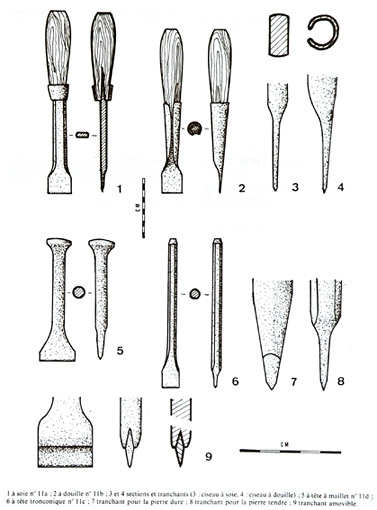
Here are several photos from eBay of stone chisels, and at top an image of traditional French designs.
Traditional French stone chisels

Stone chisels in canvas roll

Toothed stone chisels (mallet heads)

Toothed, flat, rondel, and point chisels (hammer heads)


Monday, February 2, 2015

History of Trow & Holden Co.


Trow & Holden cutter's hand hammer No. 237
Trow & Holden Co. is an iconic American maker of excellent quality tools for working stone, operating in Barre, Vermont, since 1890 (or 1889). Their tools were used to create the Lincoln Memorial, among many other notable monuments, sculptures, and buildings. They have a large number of videos on their YouTube channel, demonstrating their hand and pneumatic tools. One measure of their tool's high quality is that the pneumatic tools have serial numbers, and No. 1 still exists. It belongs to Barre sculptor Giuliano Cecchinelli, seen here on Facebook.

Trow & Holden was founded by Clark Holden (1834-1909), a native of Barre, the heart of Vermont's granite industry. At age 21 he bought the general store where he was employed. In 1865 he and a partner, Frank A. Stafford, bought a Barre agricultural fork manufacturer and ran it as the Stafford-Holden Co. and the Stafford & Holden Manufacturing Co. In 1885 Clark Holden withdrew from the business to serve as postmaster of Barre for 5 years. In 1889 he formed a partnership with John Trow, a banker, to make granite tools under the name Trow & Holden.

Trow & Holden's factory, 1906
In 1905, Clark Holden sold the business to his son, William Merrill Holden (1873-1941). The firm had outgrown its facility, and William Holden bought the Stafford & Holden Manufacturing Co.’s buildings on South Main St. in Barre. The site included a dam on Stevens Branch for powering the forges and grinding wheels. In 1911, the business incorporated as Trow-Holden Co. This aerial photograph is in a 1942 book.

The company passed to William’s son Max Albee Holden (1899-1973), who married Eula Mary Akley. Max Holden brought his wife’s brother Gordon E. Akley (1920-1992) into the business. When Max retired around 1969, Gordon Akley bought the rest of the shares.

Today, Gordon Akley’s son Norman Akley and his wife Lauren LaMorte own Trow & Holden.
According to a 2012 article, all of Trow & Holden’s products are made with CNC machines, but the plant has its original line shafts. The old water-powered drop forges and other antique equipment is stored on site, seen in a 2008 photo on Flickr, in 2014 on Facebook, and a 2008 video tour on YouTube.

Trow & Holden 1-3/4 pound cutter's hand hammer
Trow & Holden Co. 1926 catalog
Family biographies in 1914 book
Trow & Holden plant on Google Streetview
Barre Granite Association, The Sculptor monument
Rock of Ages granite quarry tour, Barre

Trow & Holden hand bush hammer No. 3L

Monday, July 7, 2014

Tools For laying Cobblestones

Stone paving for roads, sidewalks, and courtyards has been used since about 4000 BC. The stones used can be round river rocks or irregular split stone, called cobbles or cobblestones. Stones trimmed into rectangular shapes are called setts or Belgian blocks. Most old cobblestones that are not river rocks are quarry waste, chunks too small to be used for other purposes. Granite is the preferred rock for paving, if it is available.
Laying cobblestones, Hammond, Indiana
The stones are set in a base of crushed stone (small mixed aggregate), crusher run (mixed aggregate of all sizes), stone dust (the smallest crushed aggregate), sand, or earth. The advantage of the mixed particle sizes is that it is easily shoveled and raked when delivered, and compacts under pressure and water into a cohesive mass. For paving, the cobblestones are usually not cut by the installer since the sizes vary, but they may be trimmed.

Traditional tools for laying cobblestones, setts, and other paving blocks include the following:
Paving hammer, USA
Flat bladed shovel
Rake or other spreading tool
Pick
Wheelbarrow
Paving hammer for trimming
Stone chisel
Wooden or rubber mallet
Stiff broom
Mason’s line
Level

Brades Co. City Road paving hammer, UK


Boston pattern paving hammers, USA

Tuesday, December 30, 2014

History of Fayette R. Plumb Inc.

Fayette R. Plumb was one of the major American tool makers of the late 19th and 20th centuries, and their products included a variety of hammers for brick and stone. Their factory was within walking distance of Henry Disston and Sons, another firm whose market dominance was a result of high product quality, management skill, and a dedicated work force. This chronology of Fayette R. Plumb,  Inc. owes much to Yesteryears Tools.

Plumb brick hammers sold in 1924
1856 – Jonathan Yerkes (1830-1897) relocated his Moreland, Pennsylvania works to the former borough of Frankford, PA, annexed by Philadelphia in 1854.

1867 – After completing his formal education, Fayette Rumsey Plumb (1848–1905) took a job with the hardware firm Lloyd, Supplee & Walton in Philadelphia, intending to learn the hardware business. This link is a photograph of a painting of Mr. Plumb.

1869 – Plumb formed a partnership with Jonathan Yerkes. Yerkes and Plumb began building a new works in Bridesburg, another former borough just south of Frankford, adjacent to the Pennsylvania Railroad.

1887 – A complete takeover by Plumb began with Yerkes's retirement in April, 1886. Jonathan Yerkes initially sold his stake in the company to his brother Edward A. Yerkes. Shortly thereafter Edward A. sold out to Plumb but the Yerkes & Plumb name was maintained on products for some time. Other Plumb brands included Y & P with an anchor and Anchor Brand, possibly used until the 1930s.

1899 – Incorporated as Fayette R. Plumb, Inc., with Mr. Plumb as president. A manufacturing directory published the same year gives Plumb's address as East Tucker St. and Trenton Ave.

1901 – Fayette Rumsey Plumb, Jr. (1877-1966) was treasurer.

1905 – The elder Mr. Plumb died suddenly while on a trip.

1906 – Fayette R. Plumb catalog.

1910 – The company began construction of a plant in St. Louis, Missouri. The project was overseen by Calvin Perry Bascom, who then became general manager of the St. Louis facility.

Plumb's Philadelphia plant (before 1918)

1918 – Company officers and management were:
Fayette R. Plumb Jr., President
Joseph H. Plumb, Treasurer
John M. Williams, Secretary
Frank L. Campbell, Assistant Sales Manager
S. Herbert Logan, Statistician
William D. Plumb, Factory Manager
William J. Walsh, Plant Superintendent
J.A. Mellon, Comptroller

1919 – History of Plumb's production during World War I.

1920 – Fayette R. Plumb, Jr. was president, his brother William Dodman Plumb (1888-1944) was works and employment manager. The 1920 Sanborn fire insurance map shows Plumb's works on James St. between Buckius St. and Wakeling St. To see the map click this link and then scroll down Content to the sheet Philadelphia-19161929-Vol11_sheet1020. To go directly to a copy I made of the same map, click here.

1920 Sanborn map, Fayette R. Plumb
1929 – Plumb's mailing address was 4830 James St., Philadelphia. Bing Maps

1944 – William D. Plumb died.

1945 – After World War II, Fayette Rumsey Plumb II (1920-1911) entered the family business, eventually becoming vice president in charge of manufacturing. His father was William D. Plumb.

1953 – Fayette R. Plumb Jr. stepped down as president after 48 years, and was replaced by his son D. Rumsey Plumb.

1960 – Their mailing address was 4837 James, Philadelphia 37, PA.

1966 – Fayette R. Plumb Jr. died.

1971 – Plumb Company was acquired by the Ames Co. of Parkersburg, West Virginia. Ames was owned by industrialist and philanthropist Bernard Patrick McDonough Jr. (1903-1985), and labels and advertisements identified it as a McDonough Company.

1980 – The Plumb division of Ames was sold to Cooper Industries, Inc. of Houston, Texas (the date is according to a Cooper catalog). Cooper placed Plumb in its Cooper Group operating division with other hand tool brands including Crescent, Lufkin, Nicholson, Weller, and Wiss. The Cooper Group's address was PO Box 728, Apex, NC 27502.
Plumb Cooper 24 oz. brick hammer
1981–  A new Plumb factory opened at 3012 Mason St., Monroe, NC.

1982 – Fayette R. Plumb II retired as Vice President in Charge of Manufacturing; the Philadelphia factory was closed. A supermarket was built on the site north of James St., and  the building was converted to The Baptist Worship Center in 2007. One surviving Plumb building is on the south side of James St. Google Street View in September 2014 shows the rear wall of Plumb’s handle and coal storage building (below).


2010 – Cooper Hand Tools division was spun off into Apex Tool Group, a joint venture of Danaher Corp. and Cooper Industries. Apex Tool Group had over 30 brands including Plumb. “Apex is a company that Danaher and Cooper formed in 2010 by merging their individual hardware making assets. Danaher and Cooper each hold 50% of Apex Tool.” Plumb tools are being made outside the United States, primarily in China.

October 2012 – Danaher Corporation and Cooper Industries sold Apex Tool Group to Bain Capital.

Plumb's hammer brands in 1940 included these, starting with the most expensive:
Yerkes & Plumb knapping hammer
Plumb Chrome
Plumb Au-to-graf
Plumb
Plumb Favorite
Plumb Leader

Plumb's other brands, marks, and labels included these:
James West & Co. (early, second quality)
Vulcan Tool Co. (early, second quality)
Q. C. Mfg. Co. (third quality line)
Quaker City Mfg. Co. (for hardware wholesalers)
Philadelphia Tool Co. (Plumb’s bought the company)
Private label production for major hardware wholesalers

Thursday, March 6, 2014

History of Vulcan Tool Manufacturing Co.

Vulcan Tool Manufacturing Co. of Quincy, Massachusetts has made specialized paving, masonry, and steel tools. Historically, their line included 2 stone hammers, a paving hammer, hand drills, wedges and shims, Belgian paving rammer, diagonal point dog chisel, brick clamp, air-powered paving breaker bits, and tools for riveting steel. Note that the hammers are pictured without handles. I have links to several Vulcan publications:

Vulcan Tool brochure, old, undated

"The Vulcan Company, Inc. was first incorporated as Vulcan Tool Manufacturing Company in 1908 with Alexander Clark as its first president. Clark was first trained as a blacksmith in his native Scotland at age 14. He came to the United States at age 25 and opened a small blacksmith shop in Quincy, Massachusetts in 1890, which supplied tools used in local granite quarries. Quickly developing a reputation throughout the Boston area for his high quality products, Clark started Vulcan Tool Manufacturing Company; the company name being fashioned after Vulcan, the Greek patron god of workmen who used fire to forge weapons.

"Alexander Clark's son, A. Wendell Clark, entered the business in 1910. With the transition from stone to concrete being used in construction and the paralleled evolution of pneumatic hammers and rock drills, the company began to gain an outstanding reputation for the design and manufacture of pneumatic hammer tool accessories."

"A. Wendell guided the company's growth from 1942 to 1966, when his son, W. Gordon Clark became president. Under his direction, the company moved in 1978 from Quincy to a new, modern manufacturing plant in South Hingham, Massachusetts, where it is located today. The move also brought a name change. The corporate name was shortened to The Vulcan Company, Inc.
W. Gordon Clark's son, Alexander G. , became president of the company in 1985, and is still leading the business today. His son, Alex Jr., represents the fifth generation of the family to work for the company."

Vulcan has a slide show of old plant photos and company leaders on their website.

Vulcan Tools website

Saturday, September 2, 2017

History of Heller Majestic Trowels

Heller Brothers Majestic trowel etching
Majestic trowels were first made by Irvin Otto Gierman (28 Oct. 1919 - 8 Aug. 1958), a World War II veteran and welder in Chicago, Illinois. Gierman was unable to find a satisfactory trowel for his personal use, so he decided to attempt manufacturing his own. Upon seeing his work, a large Chicago wholesaler gave him an order for 600 dozen. At its peak, Majestic Trowel made 15,000 dozen annually with a workforce of 20 in Franklin Park, Illinois, near Chicago.

Heller Brothers Majestic No. 310-6 6 inch pointing trowel
On 15 Oct., 1949, Heller Brothers Company of Newcomerstown, Ohio, purchased Majestic and moved all its equipment to Newcomerstown. Heller Brothers put Gierman in charge of trowel manufacturing. Trowels fit with Heller's product line of forged tools, including a brick hammer, many other types of hammers, blacksmith's and farrier's tools, and files of all types.

Heller Brothers Co. sold to Simonds Saw and Steel Co. in 1955, and the name changed to Heller Tool Co.  According to advertisements visible on "snippet view" on Google Books, Heller Majestic brick and plaster trowels were made through at least 1957. They were etched, not stamped, with the name and logo. The etching was light and tended to wear away quickly. This makes Heller Majestic trowels difficult to find and identify today.
Heller Brothers 1.5 pound brick hammer

Hardware Age, 28 July 1949, Pg. 610.jpg


Monday, May 2, 2016

History of Charles Hammond & Son

Charles Hammond & Son was one of several forged hand tool manufacturers in the Philadelphia, PA area in the 19th and early 20th century. Hammond made many styles of hatchets, axes, brick and hand drilling hammers, and a variety of other hammers. Their lesser quality brands were Ogontz Tool Co. and Tacony Solid Steel. Hammond tools are highly regarded by collectors, and the business closed before suffering the quality decline that afflicted many makers in the late 20th century. Charles Hammond & Son's 1910 catalog is on Archive.org or for sale at Toolemera.com.

C. Hammond drilling hammer
Charles R. Hammond was born 22 June 1805 in Newton, Massachusetts, the tenth child of Thomas Hammond and Sarah Winchester Hammond. In 1809, Hammond's parents moved the family to the Shaker Religious Community in Harvard, Massachusetts, officially joining it 10 Jan 1811. This is where Charles grew to manhood and where he would have learned blacksmithing. Charles left the Shaker Religious Community on 17 Apr 1824, moving to Boston where he worked in manufacturing. Then he moved to Delaware County, PA, near Darby, where he began making cobbler's hammers and other tools required by shoemakers.

About 1844, Charles had accumulated the capital for a larger operation, and bought a former textile mill on a bend in Tacony Creek, also spelled Tookany Creek, in Cheltenham Township, Montgomery County, PA, near Philadelphia. He rebuilt the buildings to produce hammers, hatchets, and other forged tools, using his name C. Hammond. The business remained at this location until it closed in the 1930s. Originally the area was rural with many small industries along the creek. In contrast to most early tool works, Hammond was not in a town or even on a named road or railroad. As the surrounding population increased, the location's name changed from Shoemakertown to Ogontz and again to Elkins Park. Even today, there is no public road that runs through the tool works location.

It's important to note that the Tacony Creek location, area name changes, and Hammond's early use of abbreviated "Philadelphia" on tools has caused confusion with Hammond's location. Tacony Creek flows through Philadelphia, changing names to Frankford Creek, emptying into the Delaware River next to the Betsy Ross Bridge. Tacony Creek gave its name to Tacony, the Philadelphia neighborhood  further up the Delaware River where Henry Disston & Sons were located. Hammond had a sales office in 1871 at 13 N. 5th St., near Market St., and in 1901 rented an office at 523 Philadelphia Bourse. However, there is no indication in the historical record that Hammond's tool works were ever located anywhere than in the unincorporated area of Montgomery County.

In 1852, Charles made his son Charles Jr. a partner, and renamed the business Charles Hammond and Son. Charles Jr. was born in Boston, MA, 14 Oct. 1831, and learned all aspects of the business from his father. After Charles died 14 Feb. 1874, Charles Jr. continued to run it as his father had. With increasing demand, he expanded the works to cover 6 acres, with all critical building made of stone.

Charles Jr. died 6 Sept. 1899, and was lauded as an exemplary man in all ways, as his father had been. "Mr. Hammond displayed in marked degree the traits of character and tastes which characterized the father. Like him he was held in genuine regard in all circles in which he moved. He held an assured and influential position among the manufacturers of his state, who recognized in him a capable and resourceful man of affairs. He was the soul of honor in every relation of life, and was among the foremost in promoting the welfare of the community by personal effort, example and generous contribution of his means."

C. Hammond & Son, Hexamer Survey, 1877
The business then passed to Hubert Rosseau Hammond (6 Nov. 1835 to 1 Jan 1909), the son of Moses Winchester Hammond, the sixth child of Thomas and Sarah Hammond. Hubert married Sarah E. Yerkes on 31 Jan. 1859, and it's possible she was related to Jonathan Yerkes, of  Yerkes and Plumb, Philadelphia. This 2-page Pennsylvania state report gives various facts about forged tool makers and their employees in 1906.
C. Hammond brick hammer
At Hubert's death, control went to Charles Hammond Culin (1 Oct. 1867 to 27 Nov 1943). Culin was the brother of Emma F. Culin, Mrs. Charles Hammond Jr. Culin's father George F. Culin (b. 1832) had befriended the elder Hammond and the Culin family was living with Hammond in 1870. By 1880, George F. Culin was bookkeeper for the tool works.

During this period business declined, according to state records. In 1916 the works employed 48 men and 1 woman, and 5 in the office. In 1920 it was 43 men in the works and 5 office, and 1922 only 32 men in the works and 4 office.

Earl Culin Hammond (1890-1968), Charles and Emma's only son, was also a member of the firm when he registered for the World War I draft. In the 1930 US Census, his occupation was "Manufacturer, Tools", meaning that the business was still operating. In 1940, he had changed occupations to "Assistant Director, School of Music".  

Charles H. Culin's 1930 occupation was also "Manufacturer, Tools". By the 1940 US Census, he had retired, with the business presumably closed. His home at 220 Church Rd. was adjacent to the entrance to the tool works. The house is well-preserved and there is a well-worn grindstone at the left, where a private drive leads back to several secluded houses on the Charles Hammond and Son site. At least 2 of these are converted tool works buildings. Identical stone walls and pillars mark several properties surrounding the former Hammond property, on Church Rd., New Second St., and Harrison Ave. This suggests that the Hammond family and their employees built houses next to their workplace, and that the Hammonds appreciated stone masonry.           


As an aside, the elder Charles's older brother Thomas Hammond (1791-1880) wrote the music to several Shaker hymns, and 8 musical works total.