Please note

Because of the lack of published trowel and masonry tool histories, the information here is based on other sources that may be less reliable and certainly are incomplete. These include eBay and tools that I purchase myself that are the starting points for my research. I will write what I know as I learn it. If what you read here interests you, please check back often and look for revisions and corrections. Scanned catalogs are on Archive.org as pdf files. A few are links to other websites. Your photos and information are welcome. Please click on any picture to enlarge it. Comments are welcome, but any with links will be deleted as possible spam.
Showing posts with label Other American Tool Makers. Show all posts

Sunday, November 29, 2020

A Brass-Handled Concrete Finishing Trowel

Concrete, Vol. 9, No. 2, Feb. 1909

Hayden Automatic Block Co. made a concrete finishing trowel with a removable brass or aluminum handle. This is the only finishing trowel I have seen with a brass handle. The aluminum option was dropped 1909-1910.

Hayden Automatic Block Machine Co., 112 West Broad St., Columbus, OH, also made concrete block machines and concrete mixers. The company was named for William B. Hayden (1839-1916), an inventor and manufacturer. In 1924 the Kent Machine Co. of Kent, OH, purchased the right, title, and interest in all patents, patterns, machinery, tools, and equipment of the Hayden Automatic Block Machine Co. 

Concrete, Vol. 10, No. 3, Mar. 1910, page 122


Saturday, August 22, 2020

History of Ridgely Trimmer Co.

Ridgely Trimmer Co., Springfield, OH, manufactured tools and equipment for the wallpapering and painting trades, including a line of putty knives. The original business was Ridgely Decorative Co., incorporated Oct. 24, 1894 by inventor Charles T. Ridgely and several family members to manufacture tools and sell wallpaper, paint, and other supplies. Control of the manufacturing operation passed to Jerry K. Williams in Oct. 1900, and it was named Ridgely Trimmer Co. A brief summation of their long history is here. The article states that the firm went bankrupt in 1957, but we have been unable to confirm that.

Several company catalogs and excerpts of other catalogs are on the Internet Archive. 

National Painters Magazine, Vol. 50, Aug. 1923, pg. 67

The following is quoted from A Standard History of Springfield and Clark County, Ohio, Vol. 2, Benjamin F. Prince, American Historical Society, 1922, pg. 166-167:

The Ridgely Trimmer Company, of which Jerry K Williams is the active head, is a large and prosperous industry and one of the most distinctive of the manufacturing enterprises centered at Springfield. It is the only factory in the world devoting its energies exclusively to the making of tools and supplies for the benefit of the decorator, painter and paper hanger. These tools, the product of a long line of inventive effort and experience, have served to lighten the burden of the world's work, and at the same time have enabled an increasing proportion of the world's population to secure and enjoy the advantages of the decorative arts in their own homes. How the business started is an interesting story. As usual it started with an individual who recognized the need of finding better methods, and had the inventive skill to devise something better than the tools then at his command.

This individual was Charles T. Ridgely, a paper hanger. When he first started work at his trade, like hundreds of other paper hangers at the time, he used a pair of shears with which to trim his paper. The use of shears continued until he decided that he could work much faster by using a knife. He designed a special knife for the purpose. Then one day while using it the knife slipped and one of his fingers was badly cut. His wife expostulated with him for using a knife, and said that after so many years of paper hanging he should be able to invent a safe and easy way of trimming paper. A woman's good advice and an accident were the original source of the invention of the Ridgely Trimmer. The first invention was relatively crude, and modem implements manufactured under the Ridgely name have only the basic principle in common with the first trimmer devised by Charles T. Ridgely about 1882.

Shortly after he had devised the invention, Mark Smith, a son of Mark Smith, who was a pioneer of Springfield, obtained an interest in it, and together these men made an exhibit of the trimmer at the Columbian Exposition at Chicago in 1893. Their trimmer was awarded the only prize given to any device of that kind. This trimmer combined a straight edge and knife, and was used after the paste was applied. The softer the paper became the easier the machine worked and without danger of cutting the hand, chipping the straight edges or snagging the paper. A self -connecting gauge cuts the rotary blade against the straight edge and enables the operator to cut any weight paper without changing the gauge in the least.

It was in September, 1900, that Mr. Jerry K. Williams acquired the ownership of the Ridgely patents and plant. He organized a stock company known as the Ridgely Trimmer Company, and has been actively identified with the concern ever since and is its real directing head. When he took hold of the Ridgely Trimmer Company the output was one wall paper trimmer and one seam roller. The trimmer, which was then the dominating feature of the business, is now obsolete, and subsequent improvements and patents have resulted in a marvelously accurate and efficient machine now known throughout the world. Other devices have been incorporated in the manufacturing until the company now produces every tool known for the use of the decorator, painter or paper hanger. The company even employs experimental engineers whose sole business it is to devise or perfect tools that will relieve the hard work of the trade, produce more work with the same amount of labor and time, and add in general to the efficiency of an important branch of the constructive art.

The Ridgely Trimmer Company has a world-wide business. It owns a warehouse in England, and handles its business in Continental Europe, as it does in the United States, through its own salesmen and through jobbers. The company also has warehouses in Australia and South America. In the United States their warehouses are in New York City and San Francisco.

History of Meriden Cutlery Co.

 Meriden Cutlery Co. manufactured good quality cutlery in Meriden, CT, from 1855 to 1918, when Landers, Frary & Clark purchased it. As the catalog image below shows, Landers, Frary & Clark continued to make Meriden Cutlery Co. products until 1924. Meriden's products included the Anvil Brand line of putty knives with tropical hardwood handles.

W.P. Fuller & Co. Catalog H, 1924

Meriden Cutlery Co. factory, c. 1900 Source

Thursday, July 6, 2017

History of Vet-O-Vitz Masonry Systems

Vet-O-Vitz brochure 
Vet-O-Vitz Masonry Systems, Inc., of  2786 Center Rd., Brunswick, Ohio, was a manufacturer of 3 electrically powered machines for masonry. These were the Vet-O-Vitz Mortar Spreader, Wall Grouter, and Floor Grouter. A 4-page Vet-O-Vitz Mortar Spreader brochure which pictures all 3 machines is on the Internet Archive.

William Vetovitz (born in 1928) was the company owner and a bricklayer. He received US Patent 3148432 for the mortar spreader on 15 Sept. 1964. He received US Patent 3799714 on 26 Mar. 1974 for a version called a mortar applicator. The 4-page brochure is not dated, but appears to be from the 1970s. This 1975 book mentions the Mortar Spreader. By that year, Vet-O-Vitz Masonry Systems was making prefabricated brick panels for buildings and retaining walls. One of his best-known projects was for the Vontz Center in Cincinnati, Ohio. The company was in business as recently as 2013, but is now out of business.

Sunday, July 2, 2017

History of James J. Ryan Tool Works

James J. Ryan Tool Works, later J.J. Ryan Tool Co. and J.J. Ryan Corp., made a brick chisel, chisels for metal and wood, and screwdrivers. J.J. Ryan Corp., if it is still active, is the parent company for Rex Forge, a contract forging works. Ryan has always been located in Southington, Connecticut, and the Plantsville neighborhood of the same city. Southington is best known as the home of Peck, Stow, and Wilcox (Pexto), a major manufacturer of machinery and hand tools. There were number of other steel forging businesses in Southington 100 years ago.  

James J. Ryan Tool Works Catalog No. 23, 1940s   
James J. Ryan was born 3 Oct 1872 in Southington, the son of Irish immigrants. In the 1900 US Census he was single and living with his widowed father Patrick Ryan, an iron molder. James was a bolt header at Clark Brothers Bolt Co., forging a variety of bolt heads on steel rods. At the 1910 US Census, James Ryan had been married 6 years to Mary A. Callahan, and he was a machinist at the same employer.

Between 1914 and 1917, according to Southington city directories, Ryan entered business as a tool manufacturer with David E. Conners at 81 Water St., Southington. By the 1920 directory, he was on his own at the same address, manufacturing primarily screwdrivers, according the 1920 US Census. By 1930 the business was at 315 Center St., Southington. Ryan took over making the famous Perfect Handle screwdrivers when Plantsville's  H.D. Smith & Co. went out of business between 1930 and 1933. The name changed by 1951 to James J. Ryan Tool Co.  

James Ryan continued to run the business as president, retiring in 1959 at age 87. Anna, the oldest daughter of James and Mary, worked in the business, eventually becoming secretary-treasurer. Harold Francis Donnelly (1915-1996), vice president and plant superintendent in 1951, became president after James Ryan. Donnelly was married to Helen D. Ryan, the youngest daughter of James and Mary. James Ryan died in Southington 26 Jun 1974, age 101.

Ryan brick chisel
In March 1964 the business had a fire, followed about 10 years later by another which destroyed the plant. Ryan then moved its operations to Rex Forge in Plantsville, which had space available. After a few years, the companies consolidated. The date Ryan stopped manufacturing tools is unknown.

James J. Ryan Tool Works Catalog No. 23, from the 1940s, is on the Internet Archive, but their brick chisel is not in this catalog.

Sunday, May 14, 2017

History of Sands Level and Tool

Sands (or Sand's) Level and Tool Co. has been manufacturing levels and other tools since the late 1890s, with an emphasis on masonry applications. In addition, Sands made cement tools for an unknown time.

J. Sand & Sons advertisement, Feb. 1914 
Julius Sand, a bricklayer, started the business in Detroit, Michigan. He was born 28 May 1858 in Danzig, Germany, and died 13 Dec. 1929 in Detroit. According to the Sands website, Sand invented the solid-set vial and a lightweight aluminum level. Julius Sand and Julius Sand Jr. received US Patent 1,087,555 for a cast aluminum level on 17 Feb. 1914. By 1922 the firm was operating as J. Sand and Sons. In 1943 it was purchased by Unit Rail Anchor Co., the parent company of Hubbard Tool of Pittsburgh, PA. In early 1948, Sands relocated from Detroit to 601 Clinton St., Clinton, Indiana.

While in Detroit and Clinton, Sands made a line of cement tools, primarily of conventional cast iron design. They also made cement and corner tools from stamped steel, with the brand name "Clinsteel". I was unable to determine the date that this name was introduced, but it was between 1948 and 1957. There are 4 Sands tool catalogs on the Internet Archive.

Harmon Machine Co. of Wichita, Kansas purchased Sands around 1957, and Kraft Tools bought Sands in 2005.

Sands groover, Detroit, MI
Sands groover, Clinton, IN

Sands Clinsteel corner tool, Clinton, IN 
Sands Clinsteel groovers

Saturday, December 17, 2016

History of Klein-Logan Co.

Klein-Logan Co. was a Pittsburgh, PA, manufacturer of tools for railroads, paving, blacksmithing, and masonry. The following is from the company's 1944 catalog.

A BRIEF HISTORY OF THE KLEIN- LOGAN COMPANY

Origin

On July 1st 1868, John C. Klein and Frederick C. Klein, brothers engaged in the manufacture of coal picks, hand shovels, pokers and other small iron items since 1856, took as a third partner Edward P. Logan and continued business under the firm name of Klein, Logan & Co. Because the business was located in Birmingham, at that time a suburb but now that part of Pittsburgh lying along the south bank of the Monongahela River, the Birmingham Tool Works was selected as a descriptive sub-title.

Development

Pittsburgh was not only a railroad center but also the outlet of the product of the western Pennsylvania coal fields, and picks soon became a major item of the new company's products. John C. Klein, the older of the brothers, had an active, inventive mind which he directed to the then most difficult problem in the manufacture of picks— the eye. In 1874 he was granted a patent on a machine for the forging of pick eyes which, while crude and complicated if judged by modern presses, was a definite step forward.

Although soon involved in law suits with local competitors in connection with the eye machine the new firm prospered. John C. Klein, the president, was in charge of operation; F. C. Klein, vice president, in charge of sales; and Edward P. Logan, treasurer, looked after finances. Progress, if slow, was uneventful except for a fire in 1884 which destroyed the plant. Rebuilding and resumption of operations was made possible by a fortunate banking connection, Mr. Logan having been elected a director and vice president of the Iron & Glass Dollar Savings Bank, founded in 1871 to serve the community of Birmingham. At that time it was customary for business men to serve as senior bank officers, giving some time each day to advising and supervising the whole time officers. Mr. Logan served more than fifty years as vice president, president and chairman of the board of the bank. This connection continued after Mr. Logan's death in 1930, a member of the firm replacing him on the board of the bank and the president of the bank serving on the board of the present company.

A Landmark

Sledges, wedges, crow bars, railroad track tools, mining tools and blacksmith anvil tools were early added to the list of products while shovels were dropped shortly after the introduction of natural gas. In 1876 the firm showed its complete line at the Centennial Exhibition at Philadelphia, the sledges and hammers displayed being polished over all instead of on the faces only, the usual commercial practice. The highest award was given when it was shown that the mirror-like finish was not a plating but only highly polished iron and steel. Several of these tools remain today in as perfect condition as when shown 68 years ago.

Incorporation

In 1891, J. C. Klein having retired from active business and wishing to be able to transfer his interest to his children, the firm was incorporated as The Klein-Logan Company. Up to this time a son of F. C. Klein had traveled for the company, covering the entire United States and selling to hardware wholesalers in the larger cities. The appearance of distributors in smaller cities made this no longer practicable and arrangements were made with Surpless, Dunn & Co. of New York, manufacturers' agents handling many non-competitive lines, to sell in the east and middle west. Later Louis Williams & Co. of Nashville took over sales in the south and much later the E. R. Palmtag Co. of San Francisco looked after the territory west of the Rocky Mountains. Dayton, Price & Co. of New York, handled most of the exports, especially in the Far East.

The Future

Throughout the years the company has remained in the hands of the original families, management and more than 99% of the stock being controlled by direct descendants of the founders. The youngest son of John C. Klein, the only son and a grandson of Edward P. Logan now manage the business; another grandson and namesake expects to rejoin when he returns from over-seas service. A granddaughter of F. C. Klein is assistant treasurer, one grandson is shipper and three others hold key positions in production. The policy established by the partners of concentrating on the making of a few tools of the highest quality is the policy of the present management. Although the outside of the building, as shown by the photograph, remains unchanged, constant changes are taking place inside. The tools themselves have changed little in appearance; better methods of manufacture to produce tools of higher quality is and will be our constant aim.

Thursday, October 27, 2016

History of Abram Cement Tool Co.

John Dixon Abram (13 Apr. 1869 - 14 Nov. 1945) was an inventor, manufacturer, and businessman whose Abram Cement Tool Company popularized long-handle concrete finishing tools.

Concrete World, May 1915
Abram Cement Tool Co. was in business in Indiana and Detroit, Michigan from 1915 to about 1933. Their first Detroit location was in 1916 at 29 Woodward Ave., and in July 1921 they moved to 3818 Grand River Ave., about a block from Abram's home. In 1926 they moved to a better location, 2300 Michigan Ave., at the corner of 15th St. The Grand River Ave. building still exists.

Abram Cement Tool Co. building, 2300 Michigan Ave. 


John's brother Ira Martin Abram (1867-1942) invented the company's long-handled tools with articulating joints. Ira was president of Abram Cement Silo & Construction Co. of Dugger, Indiana, next to Greene County where the Abrams grew up. Abram Cement Tool Co. was established in Dugger, as a successor to Twentieth Century Manufacturing Co., 1651 Lowe St., Chicago Heights, Illinois. Later advertisements do not mention Dugger.
American Builder, Vol. 32 Jan. 1922

John D. Abram had these patents:
Horse collar, US 993,137
Tamping machine, US 1,677,422
Tamping machine, US 1,882,681

Ira M. Abram had these patents:
Trowel attachment, US 1,027,396
Trowel, US 1,074,646 (with Joseph E. Runner)
Surfacer, US 1,590,342

My scanned copy of Abram Cement Tool's Catalogue 37 is on Archive.org.

The following biography is from The City of Detroit, Michigan, 1701-1922, Volume 3, 1922.

JOHN D. ABRAM.  In commercial circles of Detroit John D. Abram occupies a foremost position as the head of the Abram Cement Tool Company, engaged in the manufacture of cement finishing tools, a product of his own inventive genius. This is one of the largest industrial enterprises in its lines in the city with a large domestic trade, while its products are also shipped to many European countries. In the control of his interests Mr. Abram has displayed marked executive ability and initiative spirit and success in substantial measure has rewarded his labors. He was born in Greene county, Indiana, a son of Frank H. and Margaret (Christie) Abram and a representative of an old American family. The father at first followed agriculture pursuits and subsequently engaged in the building of bridges in Indiana, attaining a position of prominence in that connection.

Following his graduation from the high school at Worthington, Indiana, John D. Abram there became connected with mercantile interests, with which he was identified for three years, and then went to Nebraska. Locating in Custer county, he acquired a section of land and engaged in stock raising, continuing active along that line for three years. On the expiration of that period he disposed of his interests and erected a hotel in a western town. This he later sold, and removing to Tekamah, Nebraska, he there entered the lumber and coal business, with which he was identified for fifteen years. In 1905 he came to Detroit and was employed by the Pearson & Hough Company until the 1st of May, 1916, when he established his present business as a manufacturer and dealer in cement finishing tools, conducting his interests under the style of the Abram Cement Tool Company, with offices at 3818 Grand River Avenue. These tools are manufactured from Mr. Abram’s own patent and have revolutionized the cement tool business. The prime principle upon which they work is an automatic double action, which presents the tool from digging into the cement. As the value of the output has become recognized his patronage has increased and his trade now covers every state in the Union as well as extending into Canada and many European countries. He has direct exporting connections in New York city and also maintains a direct agency at Dundee, Scotland.  During the progress of the World war Mr. Abram supplied large quantities of those tools to the United States government, having a standing contract to ship a certain quantity of tools monthly, but on the day the armistice was signed he voluntarily stopped work on the contract, thus saving the government additional expense. While engaged in this work he received an unsolicited order from a firm in the Argentine Republic, calling for forth-five thousand dollars worth of cement tools, but fearing that the tools were destined for Germany, Mr. Abram laid the matter before the United States government, which confirmed his suspicions and warmly commended him for his public-spirited action in the matter. It is needless to add that Mr. Abram refused to execute the order, thus giving unmistakable proof of his intense loyalty and patriotism. He is an astute, fair-sighted business man with the ability to control extensive interests and his business activities have ever measured up with the principles of truth and honor.

On the 24th of June, 1897, Mr. Abram was united in marriage to Miss Luella M. Houston and their many admirable traits of character have endeared them to a large circle of friends in this city. They are earnest members of the Christian church and guide their lives by its teachings. Mr. Abram is deeply interested in all that pertains to the welfare and progress of Detroit and is the president of the Builders Show Association, of which he was one of the organizers and which, owing to the liberality of Mr. Abram and other public-spirited citizens, has become a successful and popular institution, although at its inception it experienced many vicissitudes. His connection with any undertaking insures a prosperous outcome of the same, for it is in his nature to carry forward to successful completion whatever he undertakes. His initiative spirit and notable ability have carried him into important relations and while attaining financial independence he has also been a factor in promoting the industrial development of Detroit, in which city he is widely known and highly esteemed.

Engineering & Cement World, 1 Feb. 1918
Abram Cement Tool employees, Stanley Masulis at far left
Thank you for the photographs to the great-grandson of Stanley Masulis, an Abram employee in the 1920s.

Sunday, October 23, 2016

History of A.L. Swett Iron Works

1923 catalog
A.L. Swett Iron Works of Medina, New York, was a foundry which made a variety of cast iron tools, building hardware, and plumbing specialties. Their masonry tools included a brick carrier and several tampers for concrete, gravel, paving, and sod.

Albert Louis Swett (1850-1924) founded the iron works in 1889, when Swett bought out his previous partnership with William H. Samson, known as the Medina Manufacturing Co., then as Samson & Swett from 1873 to 1889.

A.L. Swett 10" x 10" tamper, maple handle
A.L. Swett Iron Works was located at 145 Glenwood Ave., Medina, a short distance from the Erie Canal. Parts of several stone buildings are still standing.

The foundry was run by son Raymond Fuller Swett (1885–1961) after his father's death. The company ceased operating in January 1961, laying off 40 employees, and the corporation was dissolved 10 Feb., 1983.

Swett's 1923 catalog is on Archive.org, but it does not include the brick carrier.      


A.L. Swett brick carrier

Thursday, October 20, 2016

History of J.S. Costello & Son Brush Co.

J.S. Costello & Son Brush Co. of Saint Louis, Missouri, was a manufacturer and dealer of brushes and trowels, particularly for the plastering trade. Founded in 1858 by John Stephen Costello, the company was in business as late as 1966. Management passed to his son Francis Xavier Costello, then to Johns's son-in-law Martin J. Brennan, and next to John S. Brennan.

Costello's 1924 catalog includes trowels and other tools sold under their name and others made by E.C. Atkins & Sons, Marshalltown Trowel, and J. Tyzack.

Catalog of Costello Brushes & Tools for Plasterers, Cementers, Tile Setters, Lathers, Moulders, 1924

The Book of St. Louisans, 1906
Costello 1924 catalog


Costello brush

Monday, July 4, 2016

History of Vlchek Tool Co.

Vlchek Tool Co. of Cleveland, Ohio is best-known for wrenches and its private-label manufacturing of Craftsman hand tools for Sears & Roebuck. Frank J. Vlchek (born František J. Vlček 4 Jan. 1871, died 10 June 1947) began in 1895 "making and sharpening tools for stonecutters and masons. By 1909 the firm was shipping hammers, wrenches, and stone cutters' tools throughout the country." Brick hammers and scutches continued to be part of Vlchek's product line until the end. The 1907 advertisement shows an F.J. VLCHEK stamp, and later tools are stamped VLCHEK.

As his business grew, Frank Vlchek was able to streamline his production lines to produce good quality tools at the lowest cost. This efficiency was the key to his success with Sears, auto makers and other large buyers. In 1959 Vlchek Tool Co. was sold to Pendleton Tool Industries Co., which merged with Ingersoll-Rand in 1964. In 1969 Ingersoll closed Vlchek's E. 87th plant, laying off 275 employees.

Vlchek's shops and plants were at these Cleveland addresses:
The Bricklayer, Mason & Plasterer, 1907
279 Lincoln Ave., occupation listed as tool dresser in 1896
1537 Central Ave., built in 1903, street was later renumbered
8017-8023 Central Ave. in 1909
10709 Quincy Ave., Google Street View below
1950 West 12th St., land purchased in 1917
3001 East 87th St.

The site Alloy Artifacts has a detailed history of Vlchek.

Vlchek 24 oz brick hammer HL240

Vlchek brick hammers 1938


Building Age, 1917
Remains of 10709 Quincy Ave. plant

Vlchek's last plant, 3001 East 87th St.

History of Ennis Manufacturing Co. and Vernontown Tools

Ennis catalog cover
Organized 24 Dec. 1929, Ennis Manufacturing Co. took over the factory of Reading Saddle & Manufacturing Co., 316 Maple St., Reading, PA. John L. Ennis had been one of the organizers of Reading Saddle in 1900. By 1944 Ennis had moved to 8th and Oley Streets, Reading.

Ennis made many of the hardware specialties that Reading Saddle had made, with fewer cast iron items and more forged steel tools. The quality of Ennis products ranged from low to average, for the household market. Later Ennis items carried the brand name Vernontown Tools. These included average quality concrete and plaster finishing trowels in carbon steel and stainless steel, guaranteed against blade breakage. Both Ennis and Vernontown items have a logo of "NS" in a diamond, a phonetic rendering of "Ennis".

Ennis's building was damaged by fire 28 Jan. 1969, but the company continued operating for an unknown time. The Vernontown trademark was taken over by Barco Industries for "masonry tools; namely, margin trowels, pointing trowels, brick trowels, plastering trowels, spreaders, floats, putty knives, linoleum knives, scrapers, groovers, edgers, and tampers."  The Vernontown trademark was cancelled 21 Feb. 2004. Barco history is covered at Yesteryears Tools.

Vernontown stainless steel plastering trowel 11'' X 4.5 ''

Wednesday, June 29, 2016

History of The Cleveland Formgrader Co.

Jasper G. Tullis during World War I
The Cleveland Formgrader Co. manufactured machinery and hand tools designed especially for road construction. These included edgers, finishing bridges, floats, formgraders, form tampers, rooters, scratch templates, strike-offs, straightedges, subgrade scrapers, and trailgraders. The formgrader, introduced about 1920 by Edward G. Carr of Chicago, IL, was a tractor equipped to prepare road grades for concrete forms.

The Cleveland Formgrader Co. was incorporated in 1930 in Cleveland, Ohio by Thomas W. Dieckman, Jasper G. Tullis, Elroy F. Schumacher, and Henry M. Toole. Jasper Garrett Tullis (1890-1964) was company vice president and head designer, with at least 4 US Patents, all assigned to the company:

US Patent 1929660 Method of making a road tool
US Patent 1952398 Road tool
US Patent 2155571 Road tool
US Patent 2425656 Conveyor mounting for trucks

Another 4 patents by others were assigned to the company:

The Cleveland Formgrader Co. 9½ inch edger
US Patent 2112349 Adjustable connection for tool heads and operating handles
US Patent 2928654 Stake puller machine
US Patent 3063676 Airport form pin puller
US Patent 3251281 Machine for forming and finishing concrete surfaces

Jasper G. Tullis was born in Kansas and worked there as a residential carpenter and as a gas engineer in California. His World War I photograph suggests that he worked in construction in the US Army. He moved to Cleveland after the war, and the 1920 US Census gives his occupation as gas and steam engineer in the machinery industry. His work with Cleveland Formgrader shows that Mr. Tullis had a talent for mechanical engineering. Later in life he moved to suburban Avon, OH, where he operated a small machine shop.        

Mr. Tullis's stepson Maurice E. Robinson (1922-2012) was a mechanical engineer for Cleveland Formgrader, and held one of the above patents.

During the 1930s, Cleveland Formgrader's plant was at 11517 Fruitland Ct., a mixed small industrial and residential area with a rail spur. By 1940, they were in a larger brick building at 6723 Denison Ave., also with railroad service. In 1955 they had moved from Cleveland to Mills Rd., Avon, OH. The company may have closed in the early 1960s. One of their machines is at the Historical Construction Equipment Association.

Cleveland Formgrader
Western Construction, Vol. 32, 1957

Saturday, June 4, 2016

History of FIBCO, F.I. Blake Co.

FIBCO finishing trowel, 11.5" x 4.5"
The F.I. Blake Company, of Worcester in central Massachusetts, was one of the United States's least known finishing trowel manufacturers. Their primary products were inside and outside calipers, dividers, drawing compasses, scribers, screw gauges, putty knives, and wall scrapers.

Frederick I. Blake founded the company with his name between 1910 and 1918. He was born in early 1868 in Maine, and worked as a machinist and superintendent of a machine shop. This experience apparently led him to begin manufacturing machinist's small tools, sharing a building at 24 Washington Square, Worcester in 1918.

After Blake's death 18 July 1930, his daughter Ruth took over the business and ran it until at least 1962. This makes her one of a very few women known to have managed a tool manufacturer.

Ruth Alice Blake was born 7 Apr 1892 in Worcester, and married John H. Beck. In May 1935 Ruth Beck began using the brand name FIBCO, and she applied for a trademark 29 Nov. 1945. By 1941, the operation had moved to 31 Shrewsbury St., Worcester, where they remained. Ms. Beck was manufacturing finishing trowels for concrete and plaster by 1958. It's unknown when the F.I. Blake Co. went out of business, but it appears to be in the early 1960s. The center of Wooster has been extensively redeveloped, and no old buildings remain at either of F.I. Blake Co.'s addresses. Frank Blake and Ruth and John Beck were living at 9 Winslow St. in 1920, and the Becks were still there in 1940.
Popular Mechanics 1953
FIBCO Multiple Gage Plate

Thursday, May 26, 2016

History of United States Cutlery Co.


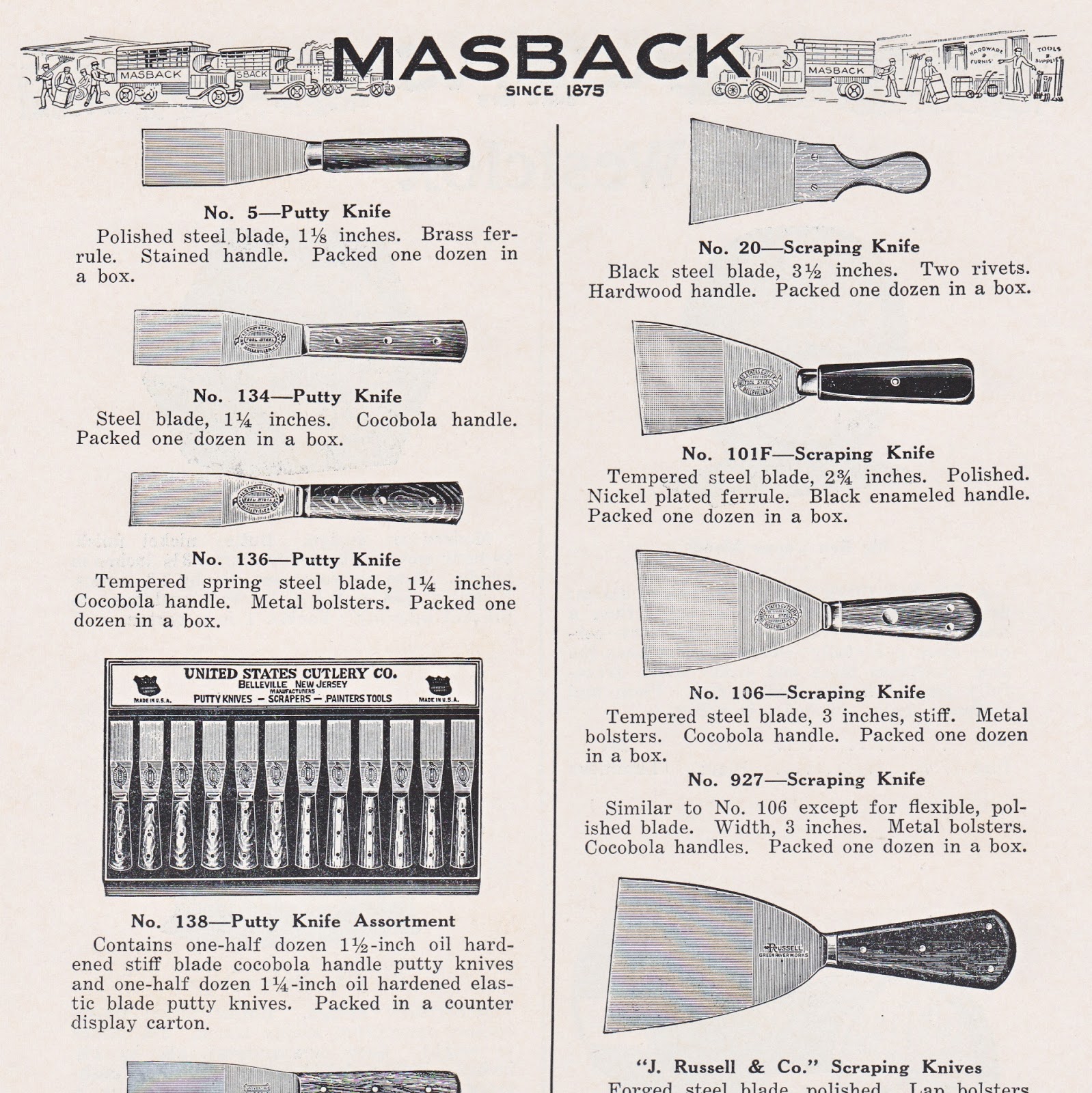
United States Cutlery putty knives, 1932
United States Cutlery Company manufactured putty knives, scrapers, cutlery, and a variety of knives. They operated from 2 and 10 Main Street, Belleville, New Jersey, next to Newark, near the Passaic River.

A 1923 announcement in the trade publication Platers' Guide said, "United States Cutlery Co., Belleville. N. J., has been incorporated with capital stock of $300,000 and has purchased the plant, machinery and raw stock of the Knickerbocker Mfg. Co., that city." Knickerbocker also made cutlery.

Elmer Abraham Greenhall (1899-1973) was United States Cutlery's production manager. Mr. Greenhall  was a Stevens Institute of Technology graduate and mechanical engineer from Brooklyn, NY, and lived in Newark, East Orange, and West Orange, NJ.

United States Cutlery Co. was still in business for at least part of 1932, but had closed by 1934, according the the Belleville city directory and other sources. Their major competitor Smith & Hemenway (Red Devil) was only a few miles away in Irvington, NJ. There is an old brick industrial building on the site and Main and Mill streets. It dates to 1940 according to a real estate listing, but could be older.

I found references to an earlier United States Cutlery Company, incorporated in Trenton, NJ, but it appears to be unrelated. It was a trust formed in 1892 by 4 cutlery manufacturers from New York and Connecticut.      

Elmer A. Greenhall, 1920

United States Cutlery putty knife, cocobola handle

Monday, May 2, 2016

History of Charles Hammond & Son

Charles Hammond & Son was one of several forged hand tool manufacturers in the Philadelphia, PA area in the 19th and early 20th century. Hammond made many styles of hatchets, axes, brick and hand drilling hammers, and a variety of other hammers. Their lesser quality brands were Ogontz Tool Co. and Tacony Solid Steel. Hammond tools are highly regarded by collectors, and the business closed before suffering the quality decline that afflicted many makers in the late 20th century. Charles Hammond & Son's 1910 catalog is on Archive.org or for sale at Toolemera.com.

C. Hammond drilling hammer
Charles R. Hammond was born 22 June 1805 in Newton, Massachusetts, the tenth child of Thomas Hammond and Sarah Winchester Hammond. In 1809, Hammond's parents moved the family to the Shaker Religious Community in Harvard, Massachusetts, officially joining it 10 Jan 1811. This is where Charles grew to manhood and where he would have learned blacksmithing. Charles left the Shaker Religious Community on 17 Apr 1824, moving to Boston where he worked in manufacturing. Then he moved to Delaware County, PA, near Darby, where he began making cobbler's hammers and other tools required by shoemakers.

About 1844, Charles had accumulated the capital for a larger operation, and bought a former textile mill on a bend in Tacony Creek, also spelled Tookany Creek, in Cheltenham Township, Montgomery County, PA, near Philadelphia. He rebuilt the buildings to produce hammers, hatchets, and other forged tools, using his name C. Hammond. The business remained at this location until it closed in the 1930s. Originally the area was rural with many small industries along the creek. In contrast to most early tool works, Hammond was not in a town or even on a named road or railroad. As the surrounding population increased, the location's name changed from Shoemakertown to Ogontz and again to Elkins Park. Even today, there is no public road that runs through the tool works location.

It's important to note that the Tacony Creek location, area name changes, and Hammond's early use of abbreviated "Philadelphia" on tools has caused confusion with Hammond's location. Tacony Creek flows through Philadelphia, changing names to Frankford Creek, emptying into the Delaware River next to the Betsy Ross Bridge. Tacony Creek gave its name to Tacony, the Philadelphia neighborhood  further up the Delaware River where Henry Disston & Sons were located. Hammond had a sales office in 1871 at 13 N. 5th St., near Market St., and in 1901 rented an office at 523 Philadelphia Bourse. However, there is no indication in the historical record that Hammond's tool works were ever located anywhere than in the unincorporated area of Montgomery County.

In 1852, Charles made his son Charles Jr. a partner, and renamed the business Charles Hammond and Son. Charles Jr. was born in Boston, MA, 14 Oct. 1831, and learned all aspects of the business from his father. After Charles died 14 Feb. 1874, Charles Jr. continued to run it as his father had. With increasing demand, he expanded the works to cover 6 acres, with all critical building made of stone.

Charles Jr. died 6 Sept. 1899, and was lauded as an exemplary man in all ways, as his father had been. "Mr. Hammond displayed in marked degree the traits of character and tastes which characterized the father. Like him he was held in genuine regard in all circles in which he moved. He held an assured and influential position among the manufacturers of his state, who recognized in him a capable and resourceful man of affairs. He was the soul of honor in every relation of life, and was among the foremost in promoting the welfare of the community by personal effort, example and generous contribution of his means."

C. Hammond & Son, Hexamer Survey, 1877
The business then passed to Hubert Rosseau Hammond (6 Nov. 1835 to 1 Jan 1909), the son of Moses Winchester Hammond, the sixth child of Thomas and Sarah Hammond. Hubert married Sarah E. Yerkes on 31 Jan. 1859, and it's possible she was related to Jonathan Yerkes, of  Yerkes and Plumb, Philadelphia. This 2-page Pennsylvania state report gives various facts about forged tool makers and their employees in 1906.
C. Hammond brick hammer
At Hubert's death, control went to Charles Hammond Culin (1 Oct. 1867 to 27 Nov 1943). Culin was the brother of Emma F. Culin, Mrs. Charles Hammond Jr. Culin's father George F. Culin (b. 1832) had befriended the elder Hammond and the Culin family was living with Hammond in 1870. By 1880, George F. Culin was bookkeeper for the tool works.

During this period business declined, according to state records. In 1916 the works employed 48 men and 1 woman, and 5 in the office. In 1920 it was 43 men in the works and 5 office, and 1922 only 32 men in the works and 4 office.

Earl Culin Hammond (1890-1968), Charles and Emma's only son, was also a member of the firm when he registered for the World War I draft. In the 1930 US Census, his occupation was "Manufacturer, Tools", meaning that the business was still operating. In 1940, he had changed occupations to "Assistant Director, School of Music".  

Charles H. Culin's 1930 occupation was also "Manufacturer, Tools". By the 1940 US Census, he had retired, with the business presumably closed. His home at 220 Church Rd. was adjacent to the entrance to the tool works. The house is well-preserved and there is a well-worn grindstone at the left, where a private drive leads back to several secluded houses on the Charles Hammond and Son site. At least 2 of these are converted tool works buildings. Identical stone walls and pillars mark several properties surrounding the former Hammond property, on Church Rd., New Second St., and Harrison Ave. This suggests that the Hammond family and their employees built houses next to their workplace, and that the Hammonds appreciated stone masonry.           


As an aside, the elder Charles's older brother Thomas Hammond (1791-1880) wrote the music to several Shaker hymns, and 8 musical works total.

Friday, April 22, 2016

History of J.W. Mixter Saw Tool Co.

Jason Woods Mixter
J.W. Mixter Saw Tool Co. of Plymouth, Massachusetts, made tools for maintaining large circular saws and a few other tools. These included the mill pick pictured in their 1893 catalog. Mill pick patents were common at this time, but I could not locate a patent for the Mixter pick. The highly tempered blade could be removed for sharpening, extended as it wore down, and replaced. It's not apparent from the picture how the blade was fastened in the head, but it may have been a wedging device. The Mixter No. 1 pick's blade was 1-1/8 inches wide and the No. 2 was 1-1/4 inches wide. Mixter picks were very expensive even with the 10 blades included, $8.00 and $10.00 in 1893.

According to the 1893 catalog, the business began in 1858 and was incorporated 1888. It was named for Jason Woods Mixter (1837-1924), born in Worcester County, MA. Nothing is yet known of his early life and training, but he married late, at age 28, to Lydia Edes, daughter of prominent Plymouth resident Oliver Edes. The marriage furthered Mixter's business interests. Mixter was a partner in zinc mines with his father-in-law and brother-in-law Edwin L. Edes, and Mixter also served on the board of directors of the Plymouth and Middleborough Railroad. Mixter's home was at 116 Court St.

Mixter Improved Mill-Stone Pick
It is unknown how long Mixter Saw Tool Co. operated, but their products were mentioned in print as late as 1912. The company appeared in business directories a decade later, although these may not be reliable. According to one source, they were at Town Square, Plymouth, city directories have the address as Market St. in 1890 and Church St. in 1905. The 1903 map below gives another location east of Sumner St., which is an apartment complex today. Mixter's was one of many industries in the 19th and early 20th century Plymouth, making rope, nails, rivets, textiles, as described in the 2008 book, A Guide to Historic Plymouth. 

Mixter himself appears to have been vigorous into old age. His wife died when he was 54, he remarried at age 73 in 1910, and he lived to age 87.

Here is the complete J.W. Mixter 1893 catalog.

Jason W. Mixter, Plymouth, MA 1903

Sunday, March 20, 2016

Ontario Knife Co.

Ontario Knife Co. putty knife
Ontario Knife Company of Ontario, New York, made a line of good quality putty knives and scrapers. Ontario is best known for their other knives and cutlery, including the Old Hickory and Tru-Edge brands. Ontario Knife Co. is still in business, and their company history is on their website.

Ontario Knife Co., undated New York City hardware catalog