 |
| American Builder Vol. 43, No. 1, Apr. 1927 p. 350 |
Showing posts with label Concrete Edgers and Groovers. Show all posts
Showing posts with label Concrete Edgers and Groovers. Show all posts
Tuesday, December 1, 2020
History of Lansing Co.

History of P.F. Connelly
 |
| Concrete, Vol. 11, No. 4, Apr. 1911, pg. 90 |
 |
| Cement World, Vol. 2, No. 6, 15 Sep. 1908, pg. 436 |
Friday, January 31, 2020
History of E. Tressing & Co.
 |
| A History of the Norwegians of Illinois, A. E. Strand, 1905, pg. 505 |
 |
| E. Tressing & Co. No. 1 groovers |
Monday, January 27, 2020
History of Wonder Manufacturing Co.
 |
| Wonder Manufacturing Co. groover |
The company president and treasurer in 1906 was Richard S. Quinn, vice president J. W. Brown, secretary W. W. Hamilton. The president and treasurer in 1912 was George Suskeep (possibly misspelled), vice president A. M. Bush, secretary and plant manager Harvey C. Wilson. The company entered receivership that year, and was reorganized in 1913 by E. L. Bush and others as New Wonder Co.
 |
| Stoves and Hardware Reporter, Vol. XXIX, No. 14, 30 Sep. 1897, Pg. 11 |
Wednesday, August 7, 2019
History of Adamite Wheel & Manufacturing Co.
 |
| Hardware and Metal, 11 July 1914 |
Thursday, November 15, 2018
History of Martin Maurer of St. Louis
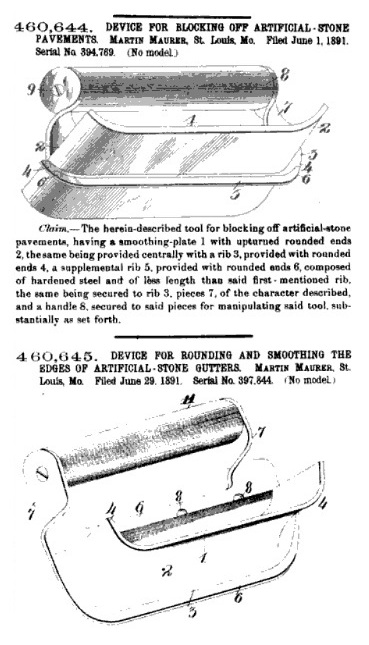 Martin Maurer operated a hardware store and machine shop in St. Louis, Missouri from 1875 to at least 1895. He invented and patented a stamped steel concrete edger and a groover in 1891, and St. Louis city directories in the early 1890s show that he specialized in masonry tools. Maurer developed and manufactured a line of concrete tools which were still being sold in the 1904 catalog of Walter A. Zelnicker Supply Co., a St. Louis hardware wholesaler.
I have been unable to find this Martin Maurer in US Census records to get his birth date, or to find a death record. There is a mention of him in the Cassville, MO newspaper 3 Oct. 1895, stating that he was to move to Louisiana. This could mean the state or Louisiana, MO.
Beginning in 1903, a Martin Maurer of Pueblo, Colorado received at least 8 patents for scales and improvements to scales. The first one used one of the same patent attorneys as the concrete tool patents. It may be the same person, but I have no verification of that.
US Patent 460,644 Device for blocking off artificial-stone pavements
US Patent 460,645 Device for rounding and smoothing the edges of artificial-stone gutters

 |
| Cassville, MO newspaper, 3 Oct. 1895 |
Sunday, October 29, 2017
Union Tool Company of Union, New York
 |
| Union Tool Co. identification |
Part of the difficulty in researching this company is that Union was a very popular name for tool manufacturers. In addition to other variations of the name, "Union Tool Company" was used by businesses in these cities and possibly more:
Augusta, Maine
Boston, Massachusetts
Goshen, Massachusetts
Torrances, California
Orange, Massachusetts
Providence, Rhode Island
Rochester, New York
St. Louis, Missouri
Union Tool Co. was also a brand name of American Fork and Hoe Co. So far as I can determine, none of these other companies made concrete tools.
 |
| Union Tool Co. No. 38 curb tool |
 |
| Union Tool Co. No. 29 narrow groover |
Sunday, September 3, 2017
History of Sturgis Cement Worker's Tools
 |
| Sturgis cement tool advertisement, date unknown |
A Google Books "snippet view" from page 571 of their Catalog No. 8 stated, "The jointer and edger illustrated below are not intended for skilled mechanics' use. They are inferior in construction to the regular line of tools...." Despite that, the tools advertised appear to be as well made as any other steel concrete tools, and the Safetred Step Tool is cast bronze, as is the bottom of the jointer pictured here.
Sturgis cement tools are quite rare. The steel tools were probably marked with a paper label which would have washed off. The adjustable jointer has "STURGIS" stamped into the edge of the bronze.
 |
| Sturgis adjustable finishing jointer, bronze |
Saturday, June 17, 2017
History of Louden Machinery Co. Cement Tools
 |
| Louden No. 2 curved edger |
Wikipedia has an excellent history of the business. "The Louden Machinery Company was an American engineering, manufacturing and design company based in Fairfield, Iowa. Founded by William Louden, the company in its early years manufactured and sold the patented hay carrier that he invented in 1867. The company later expanded into a wide variety of farm equipment and, in 1906, began an Architecture Department that reportedly designed more than 25,000 barns from 1906 to 1939." Louden also had a Canadian location in Guelph, Ontario.
 |
| Louden 1918 dairy barn plans catalog |
 |
| Louden 1928 catalog |

Sunday, May 14, 2017
History of Sands Level and Tool
Sands (or Sand's) Level and Tool Co. has been manufacturing levels and other tools since the late 1890s, with an emphasis on masonry applications. In addition, Sands made cement tools for an unknown time.
Julius Sand, a bricklayer, started the business in Detroit, Michigan. He was born 28 May 1858 in Danzig, Germany, and died 13 Dec. 1929 in Detroit. According to the Sands website, Sand invented the solid-set vial and a lightweight aluminum level. Julius Sand and Julius Sand Jr. received US Patent 1,087,555 for a cast aluminum level on 17 Feb. 1914. By 1922 the firm was operating as J. Sand and Sons. In 1943 it was purchased by Unit Rail Anchor Co., the parent company of Hubbard Tool of Pittsburgh, PA. In early 1948, Sands relocated from Detroit to 601 Clinton St., Clinton, Indiana.
While in Detroit and Clinton, Sands made a line of cement tools, primarily of conventional cast iron design. They also made cement and corner tools from stamped steel, with the brand name "Clinsteel". I was unable to determine the date that this name was introduced, but it was between 1948 and 1957. There are 4 Sands tool catalogs on the Internet Archive.
Harmon Machine Co. of Wichita, Kansas purchased Sands around 1957, and Kraft Tools bought Sands in 2005.
 |
| J. Sand & Sons advertisement, Feb. 1914 |
While in Detroit and Clinton, Sands made a line of cement tools, primarily of conventional cast iron design. They also made cement and corner tools from stamped steel, with the brand name "Clinsteel". I was unable to determine the date that this name was introduced, but it was between 1948 and 1957. There are 4 Sands tool catalogs on the Internet Archive.
Harmon Machine Co. of Wichita, Kansas purchased Sands around 1957, and Kraft Tools bought Sands in 2005.
 |
| Sands groover, Detroit, MI |
 |
| Sands groover, Clinton, IN |
 |
| Sands Clinsteel corner tool, Clinton, IN |
 |
| Sands Clinsteel groovers |
Thursday, December 29, 2016
History of W.S. Godwin Co.
 |
| W.S. Godwin edger and groover |
W.S. Godwin & Company was making cement worker's tools in Philadelphia in 1898. Godwin also sold asphalt tools and machinery beginning in 1899 from New York City. While in Philadelphia, he invented a brick and block molding machine, and filed for a US patent in 27 Jan. 1903.
He closed the Philadelphia business and moved to New York City to manufacture the molding machine with a partner, as American Block Press Company of Brooklyn, NY. In a 1904 professional directory, he was listed as general manager of that business. Godwin recommended the machine for asphalt paving bricks. The most famous American street still paved with asphalt bricks is Monument Avenue in Richmond, VA, paved from 1907 to 1910.
American Block Press Co. either failed or was renamed, because Godwin sold paving machinery from New York as W.S. Godwin for about 10 more years. By 1918, he had left New York, and was chief engineer for the International Steel Tie Co. of Cleveland, Ohio. Godwin continued to work on inventions for concrete paving.
 By 1920, Godwin had moved to Baltimore, and as W.S. Godwin Company, was making steel paving guards at 2111 Garrison Ave. In 1924 W.S. Godwin was located at W. Race and McComas Sts., Baltimore. Today, 222 W. Race St. in Baltimore houses Schuster Concrete, commercial and industrial construction. W.S. Godwin's steel paving guards catalog is on Archive.org.
Unlike his fellow business owners, William S. Godwin did not put down roots anywhere, and lived in hotels or apartments. He married late, in 1912, to Christine Keller of Brooklyn, and they had 1 child.
William S. Godwin had at least 9 patents relating to paving streets and around railroad and streetcar tracks. All are in his name as the inventor, but the last 3 are not signed by him and are after his death in 1944.
Molding-machine, publication date 28 Feb. 1905
Paving-guard, publication date Dec 9, 1919
Paved railway, publication date Aug 25, 1925
Paved or similar railway structure, publication date May 6, 1930
Curb guard and facing, publication date May 22, 1934
Shield and dowel assembly, publication date Dec 23, 1941
Dowel supporting assembly [for concrete road joints], publication date Jan 25, 1949
Road joint, publication date Apr 14, 1953
Dowel apparatus for paving joints, publication date Oct 30, 1956
William S. Godwin also wrote a poem which was printed in asphalt paving publications in 1901 and 1908, Asphaltina's Soliloquy.
 |
| W.S. Godwin groover |
 |
| W.S. Godwin bronze indent roller |
Saturday, November 19, 2016
History of C.H. Baum & Son
 |
| Cement World, 1910 |
 |
| Baum groover |
 |
| Cement World, 1910 |
Saturday, November 12, 2016
Cement Tools by Bonney Vise & Tool Works
 |
| Bonney No. 9J jointer |
 |
| Bonney No. 1CE bronze curb edger |
Bonney was known for using alphanumeric codes on their tools. Cement tools had a number with one or 2 letters, like 2CE being a #2 curb edger.
A full article on Bonney and their wrenches is at Alloy Artifacts, another history is on Tool Archives, and a short article is on Wikipedia. The 1919 Bonney Vises & Wrenches Catalog No. 19 and others are on Tool Archives. Bonney's 1967 catalog is on Archive.org.
 |
| Bonney advertising sign |
Sunday, September 18, 2016
History of Crescent Tool Manufacturing Co. of St. Louis
 |
| Gazette of the U.S. Patent Office, 1919 |
Abraham Backus of St. Louis and his son Charles M. Backus of St. Louis and Alton, IL, were early shareholders and executives of Crescent Tool Manufacturing Co., Missouri Pressed Steel Co., and Savidge Tractor Co.
In 1925 the firm reorganized as Crescent Tool & Manufacturing Co., with Dr. F.W. Grundmann (1858-1927) as president and his son Dr. William H. Grundmann (1901-1994) as vice president.
By 1932, Attilio Marcelli (1885-1964) was running the business, after working there as a machinist. Crescent Tool was listed in St. Louis city directories through 1939.
Crescent probably made the Bridge Tool Co. brand sold by Shapleigh Hardware of St. Louis.
 |
| Crescent Tool No. 70 edger |
 |
| Crescent Tool No. 70 edger |
 |
| Crescent Tool No. 153 edger |
 |
| Crescent Tool outside corner tool |
Sunday, September 11, 2016
History of Orr & Lockett Hardware Co.
 |
| Cement and Engineering News, Vol. 18 ,1906 |
Orr & Lockett was founded in 1872, with offices at 14-16 West State St., and its longstanding president was Oswald Lockett. His sons Harold and Kenneth were active in the business by 1916. When both young men were called to active military duty that year as the nation prepared for the World War, the company decided to liquidate.
Their building hardware was used in structures designed by noted Chicago architects Burnham and Root, including the famous Rookery Building.
 |
| Orr & Lockett cast iron groover |
 |
| The American Artisan, Vol. 72, 1 July 1916 |
Monday, July 4, 2016
History of Reading Saddle & Manufacturing Co.
 |
| Hardware Dealers' Magazine 1913 (note misspelling) |
 |
| Hardware Dealers' Magazine 1922 |
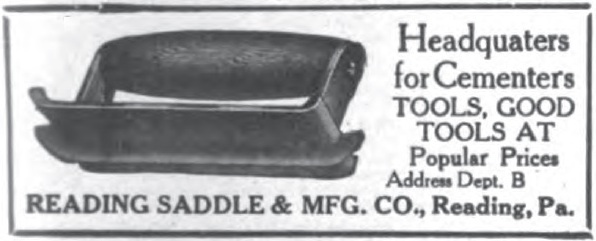
By 1922, Reading Saddle & Manufacturing Co. had expanded their plant to 316-332 Maple St., and added a weeding hoe, block planes, and a hacksaw to their large line of hardware specialties. Specifically, this included box and can openers, butcher knives, carpet stretchers, cast hammers, cement tools, chisels, clamps, cleavers, coat and towel hooks and racks, glue pots, hatchets, ice picks, levels, lunch boxes, pincers, pliers, plumb bobs, pulleys, putty knives, sad iron handles, screwdrivers, shears, spading forks, tongs, vises, wall scrapers, window sash hardware, and wrenches. Reading Saddle's products may be identified with these variations in spellings and letter spacings:
 |
| Reading Saddle #63 curbing edger |
R.S. & MFG. CO.
R. S. & MFG. CO.
Reading Saddle & Mfg. Co.
The 1929 Reading city directory lists Reading Saddle at 316 Maple St. By the end of 1929 Ennis Manufacturing Co., which also manufactured hardware specialties, had replaced Reading Saddle at 316 Maple St. John L. Ennis had been one of the organizers of Reading Saddle in 1900.
Reading, PA was also the location of the larger and older Reading Hardware Co., which had no known connection with Reading Saddle.
Reading Saddle & Mfg. Co. Cement Tools
 |
| Reading Saddle #2 edger, nickel plated |
Wednesday, June 29, 2016
History of The Cleveland Formgrader Co.
 |
| Jasper G. Tullis during World War I |
The Cleveland Formgrader Co. was incorporated in 1930 in Cleveland, Ohio by Thomas W. Dieckman, Jasper G. Tullis, Elroy F. Schumacher, and Henry M. Toole. Jasper Garrett Tullis (1890-1964) was company vice president and head designer, with at least 4 US Patents, all assigned to the company:
US Patent 1929660 Method of making a road tool
US Patent 1952398 Road tool
US Patent 2155571 Road tool
US Patent 2425656 Conveyor mounting for trucks
Another 4 patents by others were assigned to the company:
 |
| The Cleveland Formgrader Co. 9½ inch edger |
US Patent 2928654 Stake puller machine
US Patent 3063676 Airport form pin puller
US Patent 3251281 Machine for forming and finishing concrete surfaces
Jasper G. Tullis was born in Kansas and worked there as a residential carpenter and as a gas engineer in California. His World War I photograph suggests that he worked in construction in the US Army. He moved to Cleveland after the war, and the 1920 US Census gives his occupation as gas and steam engineer in the machinery industry. His work with Cleveland Formgrader shows that Mr. Tullis had a talent for mechanical engineering. Later in life he moved to suburban Avon, OH, where he operated a small machine shop.
Mr. Tullis's stepson Maurice E. Robinson (1922-2012) was a mechanical engineer for Cleveland Formgrader, and held one of the above patents.
During the 1930s, Cleveland Formgrader's plant was at 11517 Fruitland Ct., a mixed small industrial and residential area with a rail spur. By 1940, they were in a larger brick building at 6723 Denison Ave., also with railroad service. In 1955 they had moved from Cleveland to Mills Rd., Avon, OH. The company may have closed in the early 1960s. One of their machines is at the Historical Construction Equipment Association.
 |
| Cleveland Formgrader |
 |
| Western Construction, Vol. 32, 1957 |
Subscribe to:
Posts (Atom)