 |
| Hardware and Metal, 11 July 1914 |
Wednesday, August 7, 2019
History of Adamite Wheel & Manufacturing Co.

Tuesday, July 2, 2019
History of C.A. Maynard
 C.A. Maynard's Hoe and Shovel Works, of Northampton, Massachusetts, manufactured several styles of brick trowels in the late 1800s, along with agricultural tools. Their output was carried as far west as Simmons Hardware Co. in St. Louis, MO.
The works was on the banks of Mill River, below Paradise Pond. The business was originally Clement, Hawkes & Maynard, making cutlery and hoes. C. A. Maynard was Mr. Clement's son-in-law. Maynard died 1 May, 1922, age 80. His obituary stated that he had retired 3 years before, after 53 years in business.
The caption under the picture below reads:
The engravings on this page... represent what is now one of the picturesque objects in the city — the hoe and shovel works of C. A. Maynard, with a few of its products. This factory was badly injured by fire, in 1886, and will probably never again be built in its old form, but Mr. Maynard’s business is increasing so that enlargement must soon be had on the ground floor. The factory is always running full, turns out the highest priced goods in America, and gives the most value for their cost.
This photograph at Digital Commonwealth shows the back of the works before the 1886 fire.
 |
| Picturesque Hampshire by Charles Forbes Warner, 1890 |

 |
| Clement, Hawkes & Maynard cutlery 1869 |
Thursday, November 15, 2018
History of Martin Maurer of St. Louis
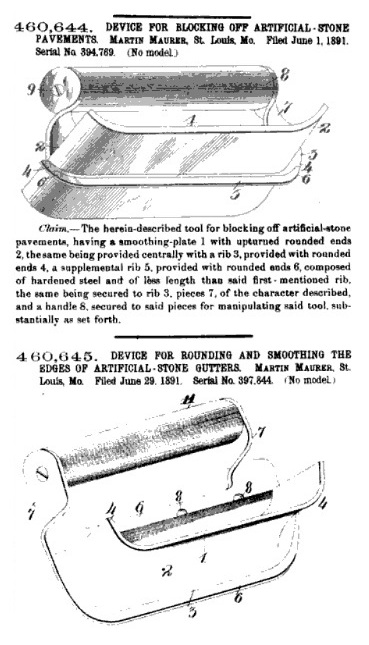 Martin Maurer operated a hardware store and machine shop in St. Louis, Missouri from 1875 to at least 1895. He invented and patented a stamped steel concrete edger and a groover in 1891, and St. Louis city directories in the early 1890s show that he specialized in masonry tools. Maurer developed and manufactured a line of concrete tools which were still being sold in the 1904 catalog of Walter A. Zelnicker Supply Co., a St. Louis hardware wholesaler.
I have been unable to find this Martin Maurer in US Census records to get his birth date, or to find a death record. There is a mention of him in the Cassville, MO newspaper 3 Oct. 1895, stating that he was to move to Louisiana. This could mean the state or Louisiana, MO.
Beginning in 1903, a Martin Maurer of Pueblo, Colorado received at least 8 patents for scales and improvements to scales. The first one used one of the same patent attorneys as the concrete tool patents. It may be the same person, but I have no verification of that.
US Patent 460,644 Device for blocking off artificial-stone pavements
US Patent 460,645 Device for rounding and smoothing the edges of artificial-stone gutters

 |
| Cassville, MO newspaper, 3 Oct. 1895 |
Sunday, June 17, 2018
Determining the Age of W. Rose Tools
 |
| 1800s |
 |
| Before 1916 |
 |
| 1887 Advertisement |
 |
| Before 1916 |
Another difference is that earlier tools use a serif style lettering, changing to a sans serif on or before 1916. On most trowels and leather tools, the lettering is right-side up when the tool is held in the right hand, but a few are reversed. These variations and their approximate dates are:
 |
| 1902 advertisement (serif style lettering is not accurate) |
W. ROSE
Serif style letters, read with handle on the right or the left
1800s
W. ROSE
PHILAD.
Serif style letters, read with handle on the right
1800s
W. ROSE
WEST PHILA.
 |
| 1916 advertisement |
Before 1916
W. ROSE
WEST PHILA.
Serif style letters, read with handle on the right
Before 1916
W. ROSE=
WEST PHILA.
Serif style letters, read with handle on the right
Before 1916
 |
| 1924 presentation trowel (engraved with date) |
W. ROSE/
Sans serif letters
1924
W. ROSE-
Sans serif letters
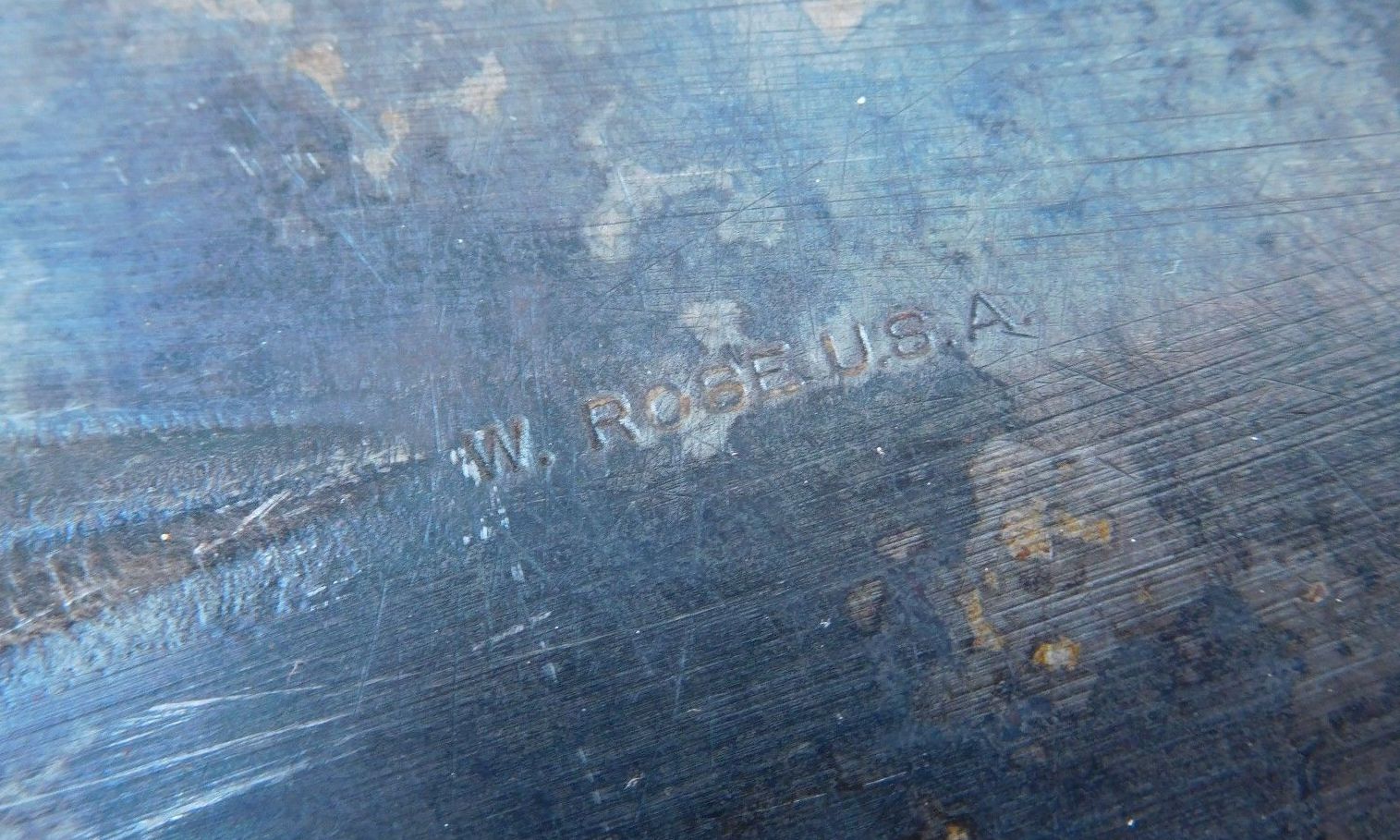
W. ROSE U.S.A.
Sans serif letters
In recent decades Rose brick trowel handles were stamped:
 |
| U.S.A. version |
MADE IN U.S.A. SHARON HILL, PA.
The catalog number and length follow W. ROSE.
 |
| 1959, stamped handle |
Tuesday, May 15, 2018
The Stone Jack
 |
| L.J. Kelly stone jacks |
The name suggests that they were originally used to lift and push blocks of stone. As industrialization progressed and the size of machinery and boilers increased, stone jacks were used to transfer these from rail car to wagon and into buildings. Stone jacks also found use in in textile mills.
Mechanically, some stone jacks are ratchets, and others use a similar design, a crank-operated rack and pinion with reduction gears. The rack and pinion are enclosed with a wood housing reinforced with iron bands. These are the only jacks made in the late 19th and 20th centuries that are part wood.
 |
| Stone jack pushing a crated boiler |
Another manufacturer of the day was L.J. Kelly of Albany, New York, who advertised his cast iron iron and steel jacks in "Granite" and other stone trade magazines.
 |
| Stone jacks made by E.R. Klemm of Chicago, IL, 1917 |
Subscribe to:
Posts (Atom)